Happy Feast of the Circumcision—for those who celebrate!
January 1 on the liturgical calendar is the eighth day of Christmas and thus the day the infant Jesus would have been circumcised and officially named. The gospel writer Luke mentions this moment explicitly (2:15-21), a rather bloody and painful reminder of the baby’s genuine humanity (which our modern calendars have tidied up considerably by referring to this day as the Feast of the Holy Name).

What seems even tidier still is the so-called “prologue” of John’s account of the Gospel (1:1-18), which many Christians heard during worship yesterday, on the first Sunday after Christmas. We might expect on such a day to hear a bit more about Mary and Joseph, or angels and shepherds, or the manger in Bethlehem. Most of us don’t expect metaphysical rhapsodies on a cosmic scale, but that’s exactly what passes for a “nativity story” in John—and I’m grateful we hear it every year in this season.
I have come to a deep appreciation of John’s Prologue over the years, mostly for how it helps me to break some visual habits and expand how I think about God and Jesus. Here are just three of those “expansions” and why I think they matter.
First, John’s Prologue leads me to question some of the longstanding spatial images of my Christian faith. I’m guessing everyone has ways of depicting and visualizing such things, and most of us probably and usually picture God residing above us in Heaven while we reside here below on Earth.
This distinctively vertical and hierarchical sense of our relationship with God is frequently depicted with a ladder—we’re on the bottom rung with all the earthy things while God is on the top rung with heavenly things.
Thinking vertically and up is not somehow “wrong” but it is quite limiting. I think John invites us to think horizontally and out: God as the very ground and foundation of life, of everything that exists, through whose Word all things come into being; we are at all times and everywhere supported and encompassed by the presence of God.
I’m especially fond of an image for this suggested by theologian Rita Nakashima Brock, which also works quite wonderfully along the shores of a great lake, where I presently live. Imagine gently rolling swells undulating across a vast body of water, always present, always moving; picture the breeze picking up and a white cap appearing on top of a large wave.
That wind is the Holy Spirit, and that whitecap is Jesus, who makes that mighty but quiet undercurrent of God’s presence visible.
That first “expansion” leads quickly to the second, especially when I’m tempted to think of Jesus as the member of a divine “committee” who gets sent down to Earth from Heaven. I wonder if anyone in the modern world has managed to escape that image—it’s very common, perpetuated by more than a few phrases in Christian liturgies and creeds, and also nowhere to be found in the Prologue to John’s gospel.
John draws our attention instead to what he calls the Logos, or the Word of God, which was with God from all time and forever, and this Word is the very means by which God creates everything there is.
This divine creative Word, John says, becomes flesh, fully united to the human person called Jesus. And here again I need to interrupt my own Marvel comic-book brain and resist thinking of Jesus as some kind of demi-god like Zeus or Thor stepping off his throne and coming down to Earth.
John’s Jesus is a fully human being of earth, and also full of grace and truth, fully united to the divine Logos, the creative Word of God.
All of this leads to the third expansion from John’s Prologue, which has been truly life-changing for me, and it takes a bit of Greek to get there.
When John declares that the Word of God dwelled or lived among us, he does not use the Greek word andros, for “man”; he does not even use the Greek word anthropos, which can be translated as “human.” Instead, John writes, the Word became sarx—the Greek word for “flesh.”
What sounds at first like a wild assertion—the Word in Flesh—finds some traction with modern anthropologists, who suggest that human language began with bodily postures and physical gestures. Speech came along later as a way to connect those postures and gestures together into sentences and paragraphs.
While I enjoy tending carefully to crafting an artful turn of phrase as a writer, our primary means of communication as human beings is actually with our bodies; and this is also true, as John seems to say, for God.
Theologian Marcella Althaus-Reid was fond of saying that when God wants to speak, when God really wants to be clear, God does so with bodies.
In a world of books (a world I love to dwell in, let me be quick to note) I must constantly remember that the Word of God does not become a concept, or a proposition, or an argument, or abstract rationality; the Word of God becomes flesh and dwells among us.
What matters about Jesus is not that he is a man, nor even that he is human, but that he is mortal flesh, just like us—just like the very first human made from dirt and breathed into life by the Spirit; just like every other creature of God made from the stuff of Earth and animated by the breath of God; just like dogs and cats, squirrels and seagulls, dolphins and whales.

I suppose we could have guessed this, but most of us didn’t: the Messiah we’ve needed all along is made from mud—just like every other mortal being of flesh. And Luke tries to make the same point with wounded genitals when the baby gets a name.
But does any of this matter? I mean, really matter? I think it does.
The world is feeling pretty wobbly these days, and quite a lot of it seems to be unraveling. Decades-long trends in American society have so distorted the Gospel that Christian faith seems hardly poised with any help at all for such a tenuous time as this.
So perhaps we need to add a new carol in our Christmas repertoire, and sing it like our lives depend on it (because I think they do).
Here’s your challenge, poets and composers, to make something singable from this: Christian faith is not an escape hatch from this world into some other world. The birth of Jesus is not a divine rescue mission; it’s a divine embrace, the Lover in full and intimate communion with the Beloved.
In that light, that great light of the Gospel, Christian faith invites us to live fully in this world, confident that God is dwelling with us—as the unshakable ground of our existence, animating us with a lively creativity, and loving us through the bodies of our companions, of all species.
Telling the Christmas story like that doesn’t matter for some finger-wagging morality about how we ought to live; I think I matters for how we truly want to live: as people fully-rooted in this precious Earth and building divinely-inspired communities of compassion, living and giving everything we’ve got for a world of peace, with justice.


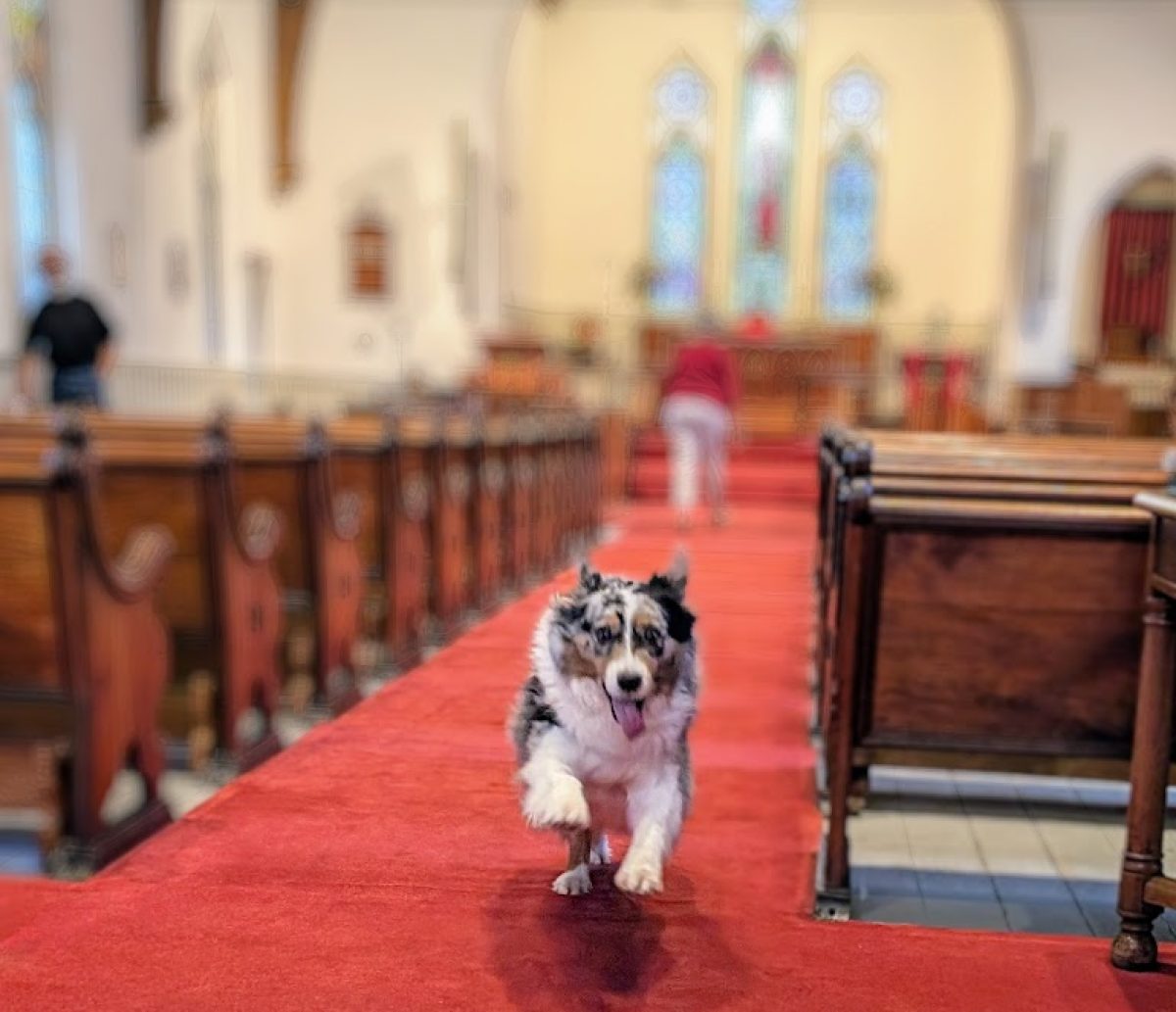
 I have been spending this Holy Week attending carefully to my Australian Shepherd dog Judah. After a “


 I actually love the smell of a wet, dirty dog. I sometimes bury my nose in Judah’s furry neck and relish that earthy, canine odor. It speaks flesh, a word made flesh, and there I remember: God really does love this glorious mess – God loves me.