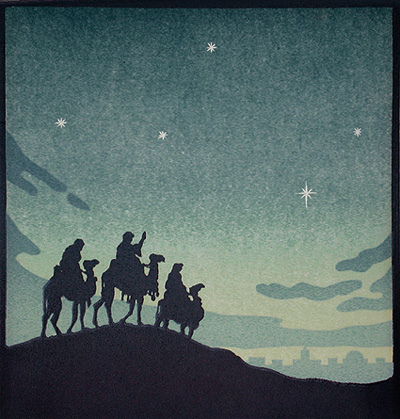
Peculiar Strangers as Divine Gifts

Strangers from the East presented extravagant gifts to the child Jesus (Matthew 2:1-12). This became known as “The Epiphany,” but I’m realizing these days that those strangers, the “Magi,” are the gifts to us—and not a moment too soon in a xenophobic world of rampant white supremacy.

“Supernova Magi,” Nikolay Malafeev

Reading the Magi as themselves gifts is thanks of course to the Gospel writer known as Matthew, who is the only one of the four canonical gospelers to include the story. It’s worth pondering why that story mattered so much to Matthew, or more significantly, to Matthew’s community, and now also to us—on this very day when many Christians celebrate the Epiphany, just as my parish did yesterday in worship.

We might recall, first, that each of the four accounts of the Gospel emerged from its own particular community of faith, each with its own demographic profile, colorful characters, and distinctive perspectives on God and Jesus. These communities had access to a variety of stories and traditions about Jesus, and eventually someone in each of these communities—or perhaps a small group—decided to write it all down and create a “gospel.” These writers adapted and revised those stories to meet the needs of their respective communities, and this helps to explain the variations among the four canonical accounts.

Scholars generally agree, for example, that Matthew’s community consisted mostly of Jewish followers of Jesus. A classic indication of this is the “Sermon on the Mount”—just as Moses brought the covenant to the people on Mount Sinai, so Matthew’s Jesus preaches about the “new covenant” on a mountain. Luke’s Jesus does this instead on a level place, a “plain.”

By noticing how these gospel writers connected traditions about Jesus to the particular issues facing their own communities, we can do the same work today—and not just theologians, pastors, or preachers, but the whole community. The Church is a “community of interpretation” where all of the members prayerfully discern how to read our sacred texts for the shared ministry to which God is calling us today.

How, then, might we read the iconic story from Matthew about the so-called “wise men” from the East, the ones who followed a star to Bethlehem and presented gifts to the child Jesus?

The divine presence in Jesus is shown to these gift-bearing strangers who were probably something like astrologers or perhaps those who practiced what we might call today an “earth-based religion.” The Greek word for these “wise men” in Matthew is magoi and it’s related to a Persian word for “powerful” (it’s also at the root of our word “magic” and “magician”). Some have suggested that this might have been a title given to Zoroastrian priests, an ancient monotheistic religious tradition that emerged from present-day Iran and Iraq. That tradition was devoted to connecting cosmic powers to earthly affairs—thus the appearance of an unusual star in the sky would have caught their attention.

Matthew’s story is often interpreted as a depiction of the global significance of Jesus—the meaning of his humble birth extends beyond Judea, and will have influence beyond the people of Israel, and reaches beyond standard borders to the East, to outsiders and foreigners. That sounds rather benign, but recalling that this is Matthew’s story, and that Matthew was likely embedded in a Jewish-Christian community, this story of the Epiphany would have been startling and should be read as both encouraging and scandalous at the very same time.

To live as inheritors of ancient Israel’s traditions and as followers of Jesus, as Matthew’s community apparently attempted, was often a complex religious undertaking. It was not always clear to which kind of religious or social category one belonged, or where one should belong. In many ways, those first-century Jewish Christians were boundary crossers—just like the Magi.

Those foreign astrologers traveled a long way, probably crossing a number of geopolitical borders. They were not Judeans, not even Israelites, so they were crossing a religious boundary as well. And these religious outsiders are among the very first to encounter Jesus—and by doing so because of the appearance of an unusual star, perhaps Matthew is suggesting that God deliberately called foreigners as witnesses to this profound moment.

Outsiders with privileged access to God’s own self-revelation: that’s a scandal that turns out to be a comfort.

Imagine Matthew’s community of Jewish Christians hearing this story: If God can lead peculiar border-crossers to God’s own presence in the flesh, then perhaps our own shifting and jumbled religious borders can be a source of insight for us as well.

Matthew’s approach to the quandaries faced by his own community seems to me quite compelling for every human community. The story about the Magi encourages us to look for epiphanies in unlikely places and among unexpected people, maybe even other species. But Matthew takes that encouraging scandal even further.

The gifts these Magi present to Jesus are not just random but function as symbols for the way Matthew wants to tell the rest of the story: myrrh was an embalming oil, prefiguring the death of Jesus; frankincense—an aromatic incense derived from medicinal plants—evoking the priestly prayers Jesus offers for our healing and thriving; and gold, representing the sovereignty of the risen Jesus, who appears on a mountain once again at the end of Matthew’s account of the Gospel, where he claims “all authority in heaven and on earth.” That mountaintop moment uniting the skies above and the ground beneath is precisely the moment those Zoroastrian Magi had dared to hope for.

“The Three Magi,” Emil Molde

Set aside those particular symbols for a moment and notice Matthew’s story-telling strategy for his community of Jesus-following Judeans: foreigners can help us navigate our own and often disorienting history.

Right there, in that strategy, is where Matthew’s Magi become gifts to us. This is the insight they embody: we need strangers and outsiders to help us interpret our own story.

Matthew’s strategy is not easy to embrace, of course, and it challenges the all-too common human tendency to gather only with those who are just like us. This is actually a cautionary tale from Matthew, warning us about borders: the walls we build for “self-protection” can instead prevent the insights of strangers from reaching us for our thriving.

The journey of the Magi offers a wonderful image for embarking on a journey into 2025, and for at least two reasons. First, the Magi were brave, setting out with only the light of a star to guide them to an unknown destination. We cannot know what’s ahead in the coming weeks and months, but the Magi themselves would encourage us with the courage of companions, and to make the journey together, trusting in divine guidance.

The second reason fortifies the first: the journey of the Magi led them to a place, Matthew says, of overwhelming joy. Whatever the coming year might hold for us, it will certainly require from us some hard work, careful discernment, and courage. Yes, and the journey itself will lead us toward joy.

Perhaps now more than ever, we need the divine gift of peculiar strangers to inspire trust on a journey toward joy. I know how trite that sounds, and this even more so: Matthew’s story can guide us along this path, like a bright star in the night sky—trite perhaps, but also vital for what it means to be “church” in an age of anxiety. Our shared faith and our brave companionship is the starry light we need.

“The Star of Bethlehem,” Waldemar Flaig

Insurrection as Epiphany

This is a strange day, for more than one reason. For the western Christians, we celebrate the Epiphany, the manifestation of the Christ-child to the Gentile world. That world is represented by the Magi, astrologers from the far East who presented extravagant gifts to the infant Jesus.

Today is also the first anniversary of an armed insurrection against the government of the United States, which took place in this nation’s capital.

Reflecting on that national horror might deepen our appreciation for why Epiphany is a major feast of the Church, one that deserves attention, observance, and celebration. It also deserves our whole-hearted devotion—a devotion that relativizes and displaces all of the other loyalties we might otherwise harbor and even cherish.

It seems important to note first that I grew up in the heart of the Midwest, in the suburbs of Chicago, steeped equally in Evangelical Christianity and American patriotism. I loved this country back then, and I still do. What was revealed about this country a year ago is heartbreaking.

In addition to that word revealed we could say “appeared,” or “manifested,” or “shown forth.” These are all synonyms for “epiphany.”

There was an epiphany about this country a year ago: our deep divisions were revealed dramatically; a festering violence appeared and erupted; some of our fellow citizens manifested a profound disregard for the very lives of some of our elected officials, including the Speaker of the House of Representatives and the Vice-President of the United States; the fragility of democracy itself was shown forth to the world.

What do Christians want to say (if anything) about an epiphany like that, especially given the epiphany Matthew portrays in the second chapter of his account of the Gospel? Do these two epiphanies have anything at all to do with each other?

There are likely multiple responses to that question, but I think we begin by pausing for longer than we usually do and puzzling over my phrase above the Magi representing the “Gentile world.” That distinction between “Jew” and “Gentile” certainly mattered for biblical writers, but most of us don’t talk that way today. No one in my little Midwestern parish wonders whether someone might secretly be a Gentile.

So that first-century language can quickly obscure why Matthew’s story should qualify as an epiphany—and not just any epiphany. Christians refer to this encounter with the Magi as The Epiphany.

Needless to say, religion can sometimes divide and fragment communities in much the same way as race and ethnicity can, or as sexuality and gender can, and certainly as partisan politics can. The Christian Church itself has been a source of division over the centuries, even violently so.

But let us notice on this day that embedded in one of the Church’s own ancient stories from Matthew are the seeds for a very different kind of world, one in which God is not the source of what tears us apart but is rather the energy that draws us together and the balm that heals us.

Matthew—ostensibly the most “Jewish” of the four accounts of the Gospel—Matthew puts this story about the Magi right at the very beginning of his account of the Good News. Matthew is the only one of those four gospel writers to give us this story of the Magi, and with it, he would seem to be urging us to let go of any sense of ownership of this story—it belongs to no one and to everyone—and he would urge us to resist any tribal triumphalism, to surrender any privileged status we imagine ourselves to have in relation to God’s love and grace or, for that matter, because of any national origin!

“Adoration of the Magi,” He Qi

The Magi declare with their gifts an astonishing and enduring beacon of hope: God is the one who presented a gift, the gift of God’s own self to us. And the “us” leaves absolutely no one out. The offering of God’s own self is for the whole world, for all people, indeed for all of God’s creation—no exceptions.

It’s time to revise how we describe the Magi; rather than saying the Magi represent the “Gentiles,” we need to say more clearly that the Magi represent all those we never imagined would be included, or those we thought would never belong with us or we with them, and the ones who never seem quite deserving of God’s love as they turn out to be the very first ones to witness that love in the flesh.

For quite some time over the last year, I thought it rather unfortunate and quite shameful, frankly, that a violent insurrection occurred on Epiphany, spoiling the feast, tainting it, and marring its brightness.

And honestly, how terribly parochial of me! As if my own distress, my own wounded patriotism, or my own country’s bruises are the full measure of whether a religious festival can still inspire us!

Beyond any doubt, plenty of other wounds and bruises and catastrophes have landed squarely on January 6th over the centuries, whether they were personal and familial heartaches or national blunders or global disasters.

What now seems so much more plain is how perfectly appropriate for all those wounds to land on this day. And for Americans on this day, the conjunction of Epiphany and insurrection seems nearly ordained.

Because now, our need for healing has appeared more clearly, and the source of our healing has been more wonderfully revealed.

“Epiphany,” James Janknegt

Abbey Road

The eleventh studio album by the Beatles, released in 1969, takes its name from the location of EMI Studios in London. The cover image of the band striding across Abbey Road quickly became a pop culture icon. That image came to mind as I worked on a sermon for the Second Sunday of Christmas and as I reflected on roads and abbeys. Here’s what I mean…

In new ways this year it occurred to me that nearly all of the stories in this Christmas season feature people who on the move: pregnant Mary with Joseph journeyed from Nazareth to Bethlehem; shepherds left their fields and flocks to go see the baby in a manger; the Magi leave their home to follow a star; and when these stories turn grim, an angel warns Joseph to flee from King Herod’s murderous rage. He then takes Mary and Jesus to Egypt, where they become political refugees.

When Herod eventually dies, an angel again visits Joseph and this time tells him that it’s safe for them to return to Nazareth—and so they migrate yet again!

All these external, physical journeys were surely accompanied by internal, spiritual ones. I think Matthew hints at this, in a rather understated way, when he brings the Magi’s story to an end in his second chapter of the Gospel: After the magi presented their gifts to Jesus, Matthew says, they “left for their own country by another road” (2:12).

They went home differently—yes, they did so for fear of Herod but also because they were different people now. We cannot encounter the Word of God in the flesh, Matthew seems to say, and remain unchanged.

Mobility and migration have marked human life from the dawn of time. We are a species constantly in motion, it would seem; whether we have lived in the same neighborhood our entire lives, or whether we’ve lost count of the geographies and communities that we’ve tried to call home, we rarely sit still.

Not all of these migrations are voluntary, of course. We are currently in the midst of a worldwide migration crisis with more displaced people and refugees than at any other time in recorded history—roughly 80 million or so. 

That number is only going to grow as our climate catastrophe and ecological collapse push people toward more habitable zones on this planet. It’s already happening around the Great Lakes, the planet’s largest basin of freshwater. Duluth, Minnesota is even advertising itself as a hub for climate refugees!

We are living today in a time of profound, even turbulent change, physical and emotional movements. and chaotic social migrations. We need to face an unraveling world directly because how we live through such a time like this matters. Biblical writers thought so, too, as they frequently linked physical migrations and the spiritual movements of heart and soul.

Theologian William T. Cavanaugh offers some help in making our outer and inner journeys a matter of spiritual practice. In his book Migrations of the Holy, he proposes three different types of human mobility, of what it looks like when humans are on the move.

The first is the mobility of the “migrant,” whose identity is defined by national borders. By controlling who and what crosses those boundaries, nation-states actually control our perceptions of other people. Borders of all kinds create the oppositional dynamics of “us” and “them.”

The second type of mobility belongs to the “tourist.” Borders are important for this type, too, because borders create that sense of “home” and “abroad.” And the tourism industry relies heavily on that distinction between “domestic” and “foreign.” Borders of this type can also exist inside one’s own country, marking the difference between cities and farms, for example, or the industrialized north and the agrarian south, or the establishment East Coast and the Hippie West Coast.

I’m especially intrigued by Cavanaugh’s third way of thinking about mobility, with images of the medieval “pilgrim.” Pilgrimage is a spiritual form of mobility very different from both migration and tourism. Pilgrims embark on a journey of repentance, almost always in company with others, and for the sake of deeper communion with God.

For pilgrims, the destination matters far less than the journey itself; and that journey intentionally joins the outer mode of movement with the inner movement of the Spirit.

Significantly, pilgrims relied on abbeys along their pilgrimage routes, religious communities that were designed as places of hospitality, worship, prayer, and education—which sounds to me like a wonderful model for what it means to be church, and why church still matters, especially at a time of such profound change and disruption as we are living through today.

It is significant that this pandemic has been prompting some truly vital questions that we might not have pondered otherwise, or certainly not to this degree.

I will never say that Covid-19 has in any way been a gift—too many have died, too many are still suffering, too many are debilitated by anxiety; it has been horrible. But it can teach us some lessons, including this: what we used to call “normal” now resides in the pandemic’s shadow, and we’re not going back there, nor should we want to.

That’s an unsettling realization, to put the matter mildly, but journeys of transformation are always disorienting, just as they were for the shepherds, the Magi, and certainly for Mary and Joseph. No one in these stories “returned to normal”—can you imagine those shepherds encountering a heavenly host of angels, running to the stable in Bethlehem, and then just returning to their sheep as if nothing at all had happened?

All of these characters were changed by the journeys they undertook, and for Mary and Joseph, also by the state-sponsored terror they escaped by fleeing to Egypt.

Let us be sure, though, to note this about such stories: God does not make bad things happen just to teach us a lesson—that is not the God of Jesus Christ; set that God aside.

The God we do worship brings good things out of the bad in a process of redemption. Living faithfully with that insight means learning how to trust that God is with us, and that God is coaxing good things out of even the most tragic moments.

That’s a discipline Christians can practice week by week at the Eucharistic Table. We do not give thanks for bad things at the Table; but we do give thanks for the goodness of God in the midst of bad things. At the Table, we remember the Cross as a way to renew our hope in the Resurrection—and that hope is in part made visible by how we live with each other. and the kinds of communities we cultivate together, and the ways we bring new life to blossom precisely where it is least expected.

I am convinced that a lot more than just a few people are hungry for this religious approach to life even when they can’t name it. And just like abbeys were for medieval pilgrims, today’s churches can in fresh ways become places of hospitality, prayer, and education in a time of deep anxiety and stress.

A thriving congregation bearing witness to the transformative love of God would be a truly wonderful thing to emerge from this truly horrific pandemic.

Might it be so, and may all of us, just like those Magi, take that abbey road homeward.

Glossy Fashion and Adoring Flesh — an Epiphany!

magi_star“Enter, stage left, the Wise Guys.” That’s what a friend of mine in college liked to say about Epiphany, the visit of the magi to the infant Jesus. Stage “left,” I suppose, because these “wise guys” hailed from ostensibly “pagan” religious traditions. “Wise,” as I have come to see in recent years, because of their quest.

The Christian quest these days seems mostly marked with institutional anxiety. How will we save the church? In my view, that is entirely the wrong question. A better one: How will any of us participate in God’s own passion to save God’s fleshy creation? Perhaps if Christians attended carefully to that question, institutional anxiety would take care of itself.

It took me some years to see this, so let me back up a bit.

In the mid-1990s a friend from seminary ripped a page out of a glossy fashion magazine and sent it to me in the mail. The full-page photograph featured a rail-thin model, scantily clothed, and lying on piles of trash. She lay there with her eyes closed, lips colored slightly purple, and a man’s foot pressing down on her arm, planted there as if in triumph. It was an advertisement for the sneaker that man was wearing.sneakers_blue

My friend included a post-it note on the photograph: “Here’s an icon for Epiphany.” This confused me at first. I found that image disturbing for more than one reason: for objectifying women as disposable play things; for perpetuating masculinity as inherently domineering and violent; and for commodifying human bodies to sell other commodities, to name just a few. Pondering my friend’s note and that image, those disturbing qualities soon began to coalesce into an icon of human flesh, its denigration, humiliation, and abuse standing in desperate need of redemption. An ideal icon, in other words, for Epiphany.

The twelve days of Christmas on the Christian liturgical calendar begin when gift-giving on the secular calendar ends, on Christmas Day itself. Those twelve liturgical days in turn end with still more gifts on the feast of the Epiphany. According to Matthew’s gospel account, magi from the East, perhaps astrologers or magicians from the region of Persia, present Jesus with gold, frankincense, and myrrh (Matthew 2:11).

Ancient Mediterranean societies sometimes used those latter two gifts for embalming, as burial spices. Matthew thus offers a literary foreshadowing of events to come. The child receiving those gifts shall not escape the fate of all mortal flesh. Indeed, he will suffer the kind of indignity no human deserves, but which continues to this day, even in the glossy pages of what passes for the latest fashion.

Icons serve as windows into an unseen or perhaps forgotten reality. The flesh portrayed in that disturbing “fashion” spread opens a window on Western culture and can help to strip away the sentimentality that so often drenches the Christmas/Epiphany holiday cycle. The original story behind those holidays actually startles, or it should.

Matthew describes the magi’s gift-bearing journey as a quest. But for what? They search not for an idea, a strategy, a program, or an institution, nor even a place, but instead for a person, a flesh-and-blood child. This child does not bear ideal flesh, the kind suitable for Greek or Roman statuary or for today’s cult of youth and beauty. The child eventually found and adored by the magi bears entirely unremarkable, ordinary flesh. Flesh ordinary enough to trade like a commodity on Wall Street, or to disrobe on Hollywood’s silver screen for quick titillation, or to go homeless and starving on city streets.

The flesh of that child appears bruised and conquered on piles of trash in a fashion magazine.

T. S. Eliot once wrote that “the hint half guessed, the gift half understood, is Incarnation.” The hint (only just intuited by ancient Persian astrologers), that gift (only barely grasped by gospel writers), the epiphany still so desperately needed today appears as this: with us and among us and in our very flesh, God takes great delight. Not abstractly or generally or vaguely but in all the material details of human life, the magnificent and tender ones as well as the heartbreaking and tragic.

communityProgressives and conservatives alike tend to extol the incarnation at Christmas, perhaps also at Epiphany, and each in their own ways. Relatively few make clear that the flesh of the Incarnation comes in a rainbow spectrum of colors (what modern Westerners call “races”), or that Western society has generally cared far more about male- rather than female-identified flesh (and still does), or that “flesh” stands for much more than whatever we mean by “human.”

Today’s liturgical feast invites Christians to do what so many of us have been taught resembles a scandal if not a sin: adore flesh – not for the sake of fashion, but to be decidedly out-of-fashion. When Christian churches figure out how to do that and why, we will change the world (for the better).

A changed world might well be what set those ancient wise guys on a long journey. Happy Epiphany!

(This post is a revised version of a section of my forthcoming book, Peculiar Faith: Queer Theology for Christian Witness. You’ll be able to pre-order it soon!)