Commentary

Hold Fast and Stay True

The horizon before us is looking a bit apocalyptic.

I suppose that could refer to the apocalyptic character of current events, but I have especially in mind the tone of the lectionary; it likely works for both.

As the liturgical year winds down, the lectionary starts assigning dramatic readings about the so-called “end” of the world. When the new year starts on the first Sunday of Advent—on December 1 this year—these apocalyptic glimpses become full-blown visions of scary times to come.

Now would be a good time to recall what that powerful word “apocalypse” means. It comes from a pretty ordinary Greek verb, actually; it means something like removing the lid from a jar. Doing that reveals or discloses what’s inside.

Eventually, this otherwise simple Greek verb wandered into religious texts where it came to mean “divine revelation,” or making hidden things visible and known.

At this time of year, the lectionary always gives us a series of biblical texts with apocalyptic themes, with moments of disclosure, and of unveiling, and often rather vivid if not also disorienting revelations.

It is of course very common to suppose that apocalyptic texts are by definition oriented toward disaster; Hollywood loves that approach for blockbuster movies. And we still use it in ordinary speech when trying to name a moment that seems particularly catastrophic.

Usually overlooked or mostly forgotten in these cultural appropriations is the energy of hope that nearly always accompanies an apocalyptic text.

“Beacon of Hope,” Keith Mengullo

“Hopeful apocalypse” now seems like a contradiction in terms, even though these ancient texts were written to be a source of comfort for communities in trouble. These communities needed to be reassured that their own moment of anxiety, even fearfulness, perhaps also threats of violence or depravation, maybe even signs of war on the horizon, that such a moment belongs to a larger and still meaningful story.

That reassurance, that sense of “meaningfulness,” might be anchored in a notion of divine design, or attached to an enduring sense of providence, or more generally the reminder of God’s own faithfulness to God’s own creation. This could easily be the very key to the whole letter to the Hebrews. In the passage assigned for yesterday, many of us heard a wonderful declaration about God: “the one who has promised is faithful” (10:23).

Apocalyptic writers want to reveal that faithfulness, to offer signs of that divine presence even in the midst of seemingly random events and figures—no, it’s not just chaos; God is still present even in the most unlikely circumstances.

Yesterday’s Gospel reading came from what is often called the “mini-apocalypse” in Mark (13:1-8). This chapter usually grabs our attention when Mark’s Jesus refers to the darkened sun and moon and the stars all falling from the sky. But first-century hearers would have been just as startled (and dismayed) by the fate of the temple.

Jesus describes the coming destruction of that holy place—not just how it will be damaged, but how it will be utterly demolished, without one single stone remaining on another.

To appreciate the level of shock this caused, we need to understand something about what was one of the wonders of the ancient world, this temple built during the reign of King Herod.

It was built on the top of a small mountain with a plaza of roughly 350,000 square feet. The walls supporting this plaza were made of enormous stones, some of them weighing as much as 400 tons each. No mortar was used between these stones, and yet no daylight passes between them. Modern engineers are baffled by how ancient builders pulled this off; even modern machines can’t move stones that big with that kind of precision.

“The Temple of Herod,” James Tissot

The plaza and the temple itself could be seen from a long distance away; it would shine brightly in the sun as many parts of it were overladen with gold and the rest built with bright white granite. (Herod himself, by the way, undertook this project with over 10,000 laborers because he wanted to secure his own “eternal remembrance—it apparently worked since we still refer to it as “The Herodian Temple.”)

The destruction of such a massive structure dedicated to the very presence of God was literally unimaginable.

Whatever Jesus thought he was doing by describing the temple’s destruction, let’s be clear that he was not rejecting Judaism, the religion of his own people. He was urging instead a kind of reorientation, to remember that toward which the temple was originally meant to point—a divine purpose that had been corrupted by social and economic injustice.

We might recall in that regard the story that comes immediately before this passage in Mark: the story about the determined and defiant widow in the temple’s outer court. Her poverty put the corruption of that system on display. Jesus calls it out, denounces the religious leaders, and then bewails the failure of the temple to embody its God-given mission.

The temple was never supposed to be an end in itself; religion is never itself the point but rather what it points toward, what it evokes, what it inspires, and especially the community it’s supposed to shape and form as God’s people in the world.

Most scholars believe Mark wrote his account of the Gospel right around the year 70, shortly after the Roman Empire crushed a Jewish rebellion and then did indeed destroy the Herodian temple—which was never rebuilt.

That unthinkable disaster shapes how Mark tells the story of Jesus: the story of what truly counts and what finally matters, the story of what is worthy of our trust.

In that sense, Mark’s entire account of the Gospel and not just this one chapter is thoroughly apocalyptic—he wants to reveal and disclose genuine reasons for hope.

Do not despair, Mark’s Jesus says, even when events seem grim and dire. Even when traditional structures crumble and heroic monuments fade—especially when this happens—God will, even then, and especially then, bring something new to light, as if the turmoil were the labor pains of childbirth.

At those very moments, God is calling God’s people to the work that matters and which will not fade—God always calls God’s people to this world-changing work, of course, but it seems most important to remember this when it the work is most needed, like right now.

Hold fast to that calling, and especially to the God who calls us to do the work of repairing the world, and healing the rifts, and making peace with justice, and loving the stranger, and caring for the orphan and widow. We do that work confident that God will be with us in that work.

“Hold fast to that confession of hope”—that’s the wonderful phrase that also comes from yesterday’s passage in the letter to the Hebrews, and it has roots in nautical culture.

“Hold fast” was the command given to sailors on deck as a storm approached. Historically, more than a few sailors tattooed that command across their knuckles, a kind of lucky charm for safety, but also as a way to remember the command while they gripped the rigging as the ship was tossed about by the wind and the waves.

It’s also important to know which parts of a sailing vessel are suitable for holding fast—some of the ropes are “working lines,” the ones that move and operate the sails and spars, and you don’t hold on to those! You hold fast instead to the “standing rigging,” which is firmly attached to the deck and the mast, and which will support you as the ship heels and rocks.

“Hold fast” was usually paired with a command to the helm: stay true. Storms can quickly blow a ship off course, and it’s not always possible to discern your course by looking at the sea, or when the horizon disappears behind banks of clouds. “Stay true” is the reminder to use the compass and to keep your heading true through the storm—precisely because the only way out is to go through, whether the storm is meteorological or political.

“Hold Fast (Heb. 10:23),” Mark Lawrence

Whatever the weeks and months ahead might bring, now is the time to embrace an apocalyptic posture: what is being revealed and disclosed?

Now is also the time to embrace once more a traditional image of the Church as a ship and the life of faith as a journey on the sea: the standing rigging—that which will keep us steady and stable—our standing rigging in the church is our worship at the Eucharistic Table; our heavenly course is set by the Gospel, and it takes us into a world longing for hope and healing.

Let us then hold fast and stay true; God is with us even on turbulent seas.

Fierce and Faithful, Persistent and Poor: Walking with Widows on the Gospel Road

In the Gospel reading yesterday morning, the road to Jerusalem in Mark’s account of the Gospel at last brings Jesus and his followers to the Holy City.

It’s worth remembering when we read this story in the U.S., where “church” and “state” seem separated on paper only, that first-century Jerusalem was the seat of Judean religious power and also Roman imperial power for the province; these two forms of power come together at the temple treasury in the story from Mark (12:38-44).

Mark wastes no time in setting the stage for violent conflict in Jerusalem. Mark’s Jesus quickly clashes with every possible authority group in that capital city; in yesterday’s encounter, it was the “scribes,” the interpreters of Mosaic Law—the religious lawyers, in other words.

Mark’s Jesus has been arguing with these scribes about a wide range of issues and his patience has simply run out. Many Christians are familiar with Mark’s rendering of that moment, but probably not with an exasperated Jesus. While rich people drop big sums of money into the temple’s donation boxes, a poor widow contributes two small coins—all the money she has.

The lectionary compilers know quite well that late autumn is the time for fundraising campaigns in most churches—thus the readings about money at this time of year. But the temple story from Mark is far too often and too crudely used to guilt people into giving more money: If even a poor widow can give all she has to the Temple, then surely you can give a bit more to the church…

Mark would be horrified by using his story that way. The poor widow in this story is not the poster child for stewardship campaigns; she is, rather, the shining emblem of God’s own commitment to a world of justice. (Ched Myers provides an invaluable resource for interpreting Mark in the frames of social and economic justice; I am indebted to his analysis of this Markan story.)

As Mark’s Jesus continues his teaching in the temple, he issues a warning: “Beware of the scribes,” he says. Beware of the religious lawyers who tell you what the law means but then “devour” the houses of widows.

That rather strange phrase refers to a first-century legal practice regarding estate management. When the male head of a household died, his estate was given over to the religious scribes to administer because the widow, as a woman, was considered unfit to do so. (And by the way, lest we look down with smugness on that ancient practice, let us not forget that women in the United States were not allowed to have a credit card or take out a loan in their own name until 1974.)

Back in the first century, the scribes were compensated for their estate services by taking a percentage of the estate. As you might imagine, abuse was common in this system, forms of embezzlement to the point of impoverishing the widows—or as Mark’s Jesus puts it, the houses of widows were devoured.

“Beware of these religious scribes,” Jesus says, and then he sits down “opposite the treasury,” Mark says—a phrase we should read as not merely about geographical location but moral orientation: over and against it, as opposed to the temple treasury, where this social and economic abuse of widows is on display.

Quite honestly, after many decades of reading and hearing this story, I have consistently failed to see Mark’s point in telling it. The reason the widow is poor in this story is because the scribes have stolen her money—some of which they were putting in the offering plate, right in front of Jesus! These religious experts would have known that the Mosaic Law they claimed to interpret explicitly provided for the care of both widows and orphans; it was a divine commandment.

But right there, in the temple of God’s presence, the scribes no longer protect the poor but crush them, and then flaunt it. Right there in the outer court of the temple, economic oppression is on display and barely concealed with “long prayers,” as Mark puts it.

Jesus is outraged.

Despite all the pietistic sermons I have heard (and yes, preached) in the past about this impoverished woman giving all she has, Jesus is not commending the widow for her religious piety; he’s calling out the scribes for their religious hypocrisy. Jesus then leaves the temple in disgust, and, it turns out, for the last time before he is arrested and killed.

Among the four gospel writers, Mark is especially keen to address economic injustice as a vital component of the Gospel. Mark is also eager to point out how religion gets used to support the financial inequities of social systems—systems that are almost always designed to favor men.

When Mark’s Jesus insists that the poor widow has actually given more than all the rich people, he is not congratulating her or recommending this practice; he’s drawing attention to the injustice of a system in which the poor contribute proportionally far more to the system than those who are wealthy, a common dynamic in nearly every human society throughout human history—including the United States.

This kind of social and economic analysis can make most of us deeply uncomfortable, including me. But that is precisely the “discomfort zone” the Gospel calls us to inhabit, and I am fairly confident that this will increasingly be the case in the weeks and months to come.

Given the rocky road likely ahead of us, it’s worth remembering that the road to Jerusalem in Mark is the good road of the Gospel, the one that leads not only to the Cross but also the Empty Tomb. The good road of the Gospel marks a journey of costly discipleship for the sake of flourishing—for all. The good road of the Gospel is not easy to find, but just ask anyone on the margins of a wealthy and powerful world; they will have a map.

The many books of the Bible, written over many centuries by different communities, are remarkably consistent about this: care for the orphan, the widow, and the stranger is religiously non-negotiable; and resisting unjust systems of oppression is the very definition of discipleship—not because people on the margins deserve our pity (that tired old noblesse oblige of the wealthy West) but because the excluded and forgotten can usually show us the best road home.

Yesterday’s lectionary texts all confirm this—from the story in the Hebrew Bible about Elijah and the widow of Zarephath, a city of Gentiles and outsiders (1 Kings 17:8-16); or from the psalmist who praises God for giving justice to the oppressed, care to the stranger, and who sustains the orphan and widow (Ps. 146); and of course from Mark, whose story in the temple I now read quite differently than I ever have before: the poor widow embodies a fierce faithfulness, the persistence to live with the dignity God gave her while living with virtually nothing that the world should have given her.

Searching for appropriate visual images for worship this past week, I did a Google search for “poor widow,” and the usual suspects appeared immediately. But scrolling down the screen I stumbled on an odd match: “The Calla Lily Vendor,” by Alfredo Ramos Martinez. I still can’t figure out why Google included this one, but I’m glad for it. The “poor widow”—too often a frail old lady in my imagination—is just as likely a determined single mother doing whatever she must to care for her children as she is a demure recipient of social security checks.

“Calla Lily Vendor,” Alfredo Ramos Martinez (1929)

The stubborn faithfulness of widows—my own dear mother embodied this to the very day she died—showed up in all sorts of guises in recent days. A gay friend of mine posted on social media last Wednesday morning, the day after the election. He wrote about waking up disappointed and also afraid. “But then I realized,” he wrote, “that I woke up with the same two arms and the same two hands that I had yesterday. I realized that no election can take away my capacity for kindness, and love, and service.”

He noted that this election might very well take away his rights as a gay man; it might take away still more rights from women, who are already afraid for their safety. While this election might very well cause harm in countless ways, he wrote, “I will continue to choose kindness and love and service.”

That’s exactly the good road of the Gospel God always calls us to walk but especially right now. Mark’s story in the temple offered me a powerful reminder about how we learn to walk that Gospel road: in solidarity with the poor in a rich world; and with women in a patriarchal world; and therefore and also with LGBTQ people in a world of bullies.

“Road of Hope,” Anastasia Arsenova

Standing in solidarity with all those on the margins is a Gospel posture.

Walking with them is the way of discipleship.

Offering kindness and love to each other on the road is our service of healing.

This is always true, and that has always been how disciples of Jesus walk the Gospel road home, regardless of election outcomes.

Yes, and, I think it is especially true right now.

Who are “We” at the Table Now?

How could this happen? I am absolutely gobsmacked, not only that he won but even more that the vote wasn’t particularly close. Even those who support him are a bit surprised. What do we make of this? How did we get here? Who are “we”?

I’m not a political pundit, but I am invested in politics, as every religious leader should directly admit. “Politics,” a word deriving from the Greek polis, or “city,” refers to all the many different ways we structure our societies and negotiate with others for resources and strategize for ways (hopefully) to advance the common good. In that sense, religion is by definition thoroughly political (as all of the ancient Hebrew prophets and also the Christian Gospel writers demonstrate, as well as the liturgical texts in The Book of Common Prayer).

It’s from that perspective that I’m inviting the parish I am privileged to serve to reflect on this moment in American cultural and political history and how we should now live our faith in public. I would have likewise invited this reflection had Ms. Harris won the election, but the invitation now feels laced with urgency, especially as the “common good” seems alarmingly fragile.

Photograph by Adi Goldstein

Who are we? I keep returning to that question, in large measure because an individual does not a social movement or a political party make. This is often difficult to keep in mind concerning Donald J. Trump, whose sheer force of personality fills a room—or an arena. Quite honestly, I haven’t wanted to suppose that Mr. Trump represents anything other than himself, someone whose public statements and moral character—in all frankness—I find reprehensible.

Never could I have imagined a convicted felon and instigator of insurrection running for President of the United States (much less actually winning), a man who mocks disabled people, advocates violence, and sexually assaults women.

But no, putting my attention there, on one person’s moral failings is a mistake. The election wasn’t about him; it was and still is about our neighbors. Focusing entirely on him risks distracting us from the vital work ahead in a deeply divided country—I mean, the work of trying to understand our neighbors, and in this case, “neighbors” for me refers to those who voted for Mr. Trump.

The week before the election, the New York Times Magazine published an essay on the work of Robert Paxton, a leading historian of fascism, whose award-winning 1972 book on the French collaborators with Nazi Germany analyzed the emergence of Vichy France during World War II.

Paxton was at first reluctant to apply the term “fascism” to the MAGA movement in the Republican Party but now believes we should, though with caveats (the character of this moment in world history is not the same as it was in the 1930s, for example). Whatever else we want to say about “Trumpism,” Paxton said, we need to note carefully that this is a “mass phenomenon” from below, and the “leaders are running to keep ahead of it.” This isn’t really about Donald Trump at all—he’s mostly a convenient means to an end. Paxton’s point about this is quite startling (if not alarming): “Trumpism,” he notes, has a much more solid and broader base of support in the American electorate than either Hitler did in Germany or Mussolini did in Italy.

Paxton also cautions against thinking of fascism as an “ideology” or a kind of “party platform.” That approach obscures the action-oriented character of a movement that is not rooted in any coherent philosophy but instead fills the void in a cultural system that has broken down or failed. This is why, in part, Paxton is still somewhat hesitant about the fascist label, which implies more stability for a cultural moment than likely exists. This, it seems to me, is a large part of what makes understanding my neighbors so challenging: not everyone votes the way they do for the same reason.  

While David Brooks urges us to see in this election a resounding No to “liberal elites”—and there is likely some truth to that analysis—I worry that this framing of the outcome reduces our social complexity to a single cause, or even worse, perpetuates what has been a long trend of American anti-intellectualism, as if “education” leads inevitably to tribal betrayal.

As Paxton would suggest, this moment is manifesting a multiplicity of convictions, grievances, aspirations, and motivations, some of which likely stand in opposition to the others even though they all inspired the same vote. The working poor in rural America may feel mostly abandoned by politicians but that’s hardly cause for common cause with high-tech billionaires who want to erase government regulations.

As I sort through all of this (and more) for my work as a parish priest, I keep returning to what has always been the focus of my vocation: the Eucharistic Table. While it’s important to keep saying that “all are welcome, no exceptions” (which I say every single Sunday at the beginning of worship), I now worry in ways I haven’t before about whether this invitation covers over the differences among those who gather at the Table—and some of the differences are clearly deep and profound.

I worry, in other words, about turning the Eucharist into a ritual of avoidance, a kind of shared denial about what keeps us separate and segregated. (This has of course always been the risk concerning racial differences in a white supremacist society as well as the differences of gendered sexuality in a patriarchal world.) If table fellowship amounts to merely a superficial unity, then “church” is not much more than a cultural cliché.

“The Best Supper,” Jan Richardson

I certainly do not mean that how one votes matters for how we gather at the Table, but I do mean that how one lives matters after we leave the Table. And that’s why the difference between “partisan” and “political,” though subtle, remains so vital.

I believe Eucharistic formation shapes Christian people to stand in solidarity with the poor, advocate for the vulnerable, work for peace with justice, and commit to a lifelong path of ongoing conversion to the Gospel of Jesus Christ—whose body we ourselves become at that Table as Christian people. The Table also reassures us of divine forgiveness when we fail to live as Christian people, and also the never-failing love of God, which is always freely offered regardless of how we live.

More succinctly: Eucharist welcomes everyone and leaves no one unchanged.

Eucharistic fellowship is, apparently, just as complex as American electoral politics. This has likely always been true, but now, perhaps, we know it in a new way.

But who, exactly, are we?

“Table Fellowship,” Sieger Koder

Unbound and Unbinding

The energy and anticipation were palpable yesterday morning as the choir rehearsed and the liturgical ministers began to vest. We gathered on a hill overlooking the Kalamazoo River, that leads into Lake Michigan, that great inland sea. We gathered as All Saints’ Parish for the 156th celebration of All Saints’ Day.

“Communion of Saints,” Elise Ritter

We celebrated a rich history of prayer and service on that shoreline hill, a legacy we prayerfully seek to honor by the way we live today and the witness we bear to the Gospel of Jesus Christ. We have recently been using the image of the “good road” to describe this journey we are on together as a parish, and that road is both inspiring and challenging.

All Saints’ Day marks the beginning of Native American Heritage Month, for example, a November observance in this country that started back in 1990. Modern Western society needs to retrieve at least part of this truly rich heritage of indigenous peoples for the sake of ecological healing in a world of climate chaos and for a healthier relationship with the land.

At the same time, we have started recently to confront more directly another part of this heritage, both as a country and as The Episcopal Church. I mean the painful legacy of residential boarding schools for indigenous children—this isn’t only part of our distant past; some of these schools just closed in our lifetimes.

Stories from these schools were in the news just a week ago when President Biden formally apologized for the government’s role in creating them. The collusion between church and state represented by these schools—this collaboration to erase the cultural traditions of an entire people—this is a gut-wrenching chapter in American religious history, our history.

Telling the truth and hearing the truth about this history is the only way to begin healing the trauma of that history. That kind of truth-telling is part of what it means to travel together on “Creator’s good road,” especially with the healing power of love.

Speaking the truth in love has always been the saintly work of God’s people. In John’s Gospel alone, this vital significance of the truth is mentioned no fewer than twenty-one times. Jesus is the “Word made flesh,” John says, “full of grace and truth” (1:14).

John’s Jesus himself declares that he is the “way, the truth, and the life” (14:6) and promises to send the “Spirit of truth” who will guide us into all truth (16:13) Because, John’s Jesus says, when you know the truth, the “truth will make you free” (8:32).

This healing and liberating power of God is on dramatic display in the familiar story from John assigned for the celebration of All Saints’ Day (11:32-44). Lazarus, a dear friend of Jesus, has died. Lazarus may well have been the closest friend Jesus had, and he was part of an intimate circle of friends that included the sisters of Lazarus, Mary and Martha, and a wider circle still of the village of Bethany, where they lived, just outside of Jerusalem.

So this family of friends, this village, gathers to grieve the loss of Lazarus. Jesus himself is so deeply moved that he begins to weep. Mary speaks some hard truth: If you had been here, she says to Jesus, Lazarus would not have died.

As many will recall, Jesus responded by raising Lazarus from the dead. But what many of us don’t often remember is that this moment is not the end of the story, perhaps not even the climax; notice what happens next. The dead man came out of the tomb, John says, and his hands and feet were bound with strips of cloth, and his face wrapped in a cloth. Jesus then said to them—to that family of friends, to that village—“Unbind him, and let him go.”

What a strange moment in this already dramatic story! It’s as if being raised from the dead is not enough, somehow not sufficient for embracing new life. Indeed, as he is walking out of his own tomb, John still refers to him as “the dead man.”

Unbind him, Jesus says, and let him go.

“Praying Lazarus,” Donald Bradford

Lazarus is wrapped in a burial shroud—tightly wrapped. That’s how they embalmed a dead body in that society, securely bound by heavily spiced linens soaked in aromatic ointments.

I think John is imagining more here than only the burial shroud of a first-century Judean. John is likely urging his readers to consider that we—all of us—might still be clinging to death even in the midst of life; that we—all of us—might still be in death’s enchanting thrall even as we hope for life; that we human beings have trouble, often deadly trouble in letting go of death.

Whatever keeps us attached to a violent system, whatever binds us to hateful speech or traps us in spirals of bodily shame, whenever we are entangled or enticed by bitter resentments—even a burial shroud can seem appealing when soaked in sweet-smelling herbs—whatever prevents us from the fullness of life needs to fall away.

Unbind him, Jesus says, and let him go.

That is the moment of love’s healing power in this story, and that’s always the work of all the saints, to unbind—to release and to liberate, to let the captives go free from whatever form of death shackles them to the past.

“See,” God says, “I am making all things new.”

That’s a powerful declaration from the Revelation to John, which the lectionary assigned as well for our saintly celebration (21:1-6a). And it’s tempting to hear it as a moment of erasure, of wiping the slate clean, as if God is simply starting over and beginning entirely from scratch.

But no, our history matters. Our history that made us who we are and shaped our families and built our communities matters, and it’s not just simply thrown away.

And the indigenous history of the people we tried to erase on this continent—that history matters just as much as ours. Our shared history with them is not erased in John’s vision—it is remade with the healing power of God’s love.

That’s the good road to travel as God’s people, and yes, this road includes difficult, even heartbreaking moments of truth-telling. But this is not the road to nowhere; it actually does go somewhere, and the selection from the prophet Isaiah for All Saints’ Day says where exactly it leads (25:6-9).

The road leads, Isaiah says, to God’s “holy mountain,” a mountain where the burial shroud cast over all people is lifted, and where God—God!—wipes away the tears from every face—including, surely, the tears from the face of Jesus himself when he wept for his friend Lazarus.

Both Isaiah and John offer a remarkable vision of ever-widening circles of who counts as “God’s people”—an ever-expanding “Communion of Saints.” For both of these ancient writers, tears are wiped from all faces; no one is left out.

Personally, I needed that biblical reassurance this week, especially as the anxiety is running high about the election tomorrow. But here’s the thing: regardless of what happens, no matter who wins and what kind of future we think we might be facing in this country, the shared ministry of God’s people remains the same. As the Book of Common Prayer succinctly frames it, our work is always to promote justice, peace, and love—and that will not change.

In the historic carpenter gothic sanctuary on the corner of Grand and Hoffman Streets in Saugatuck, Michigan, we will continue that holy work and we will extend our Eucharistic fellowship outward, in ever-widening circles of God’s healing love.

And we will keep on doing this work together for another 156 years—or for however long God calls us to do it along this good road.

And what a wonderful day it was yesterday—to recall with song and flowers and food—that we are not alone on that road but accompanied by a vast communion of companion saints.

“The Best Supper,” Jan Richardson

Pierced by Beauty

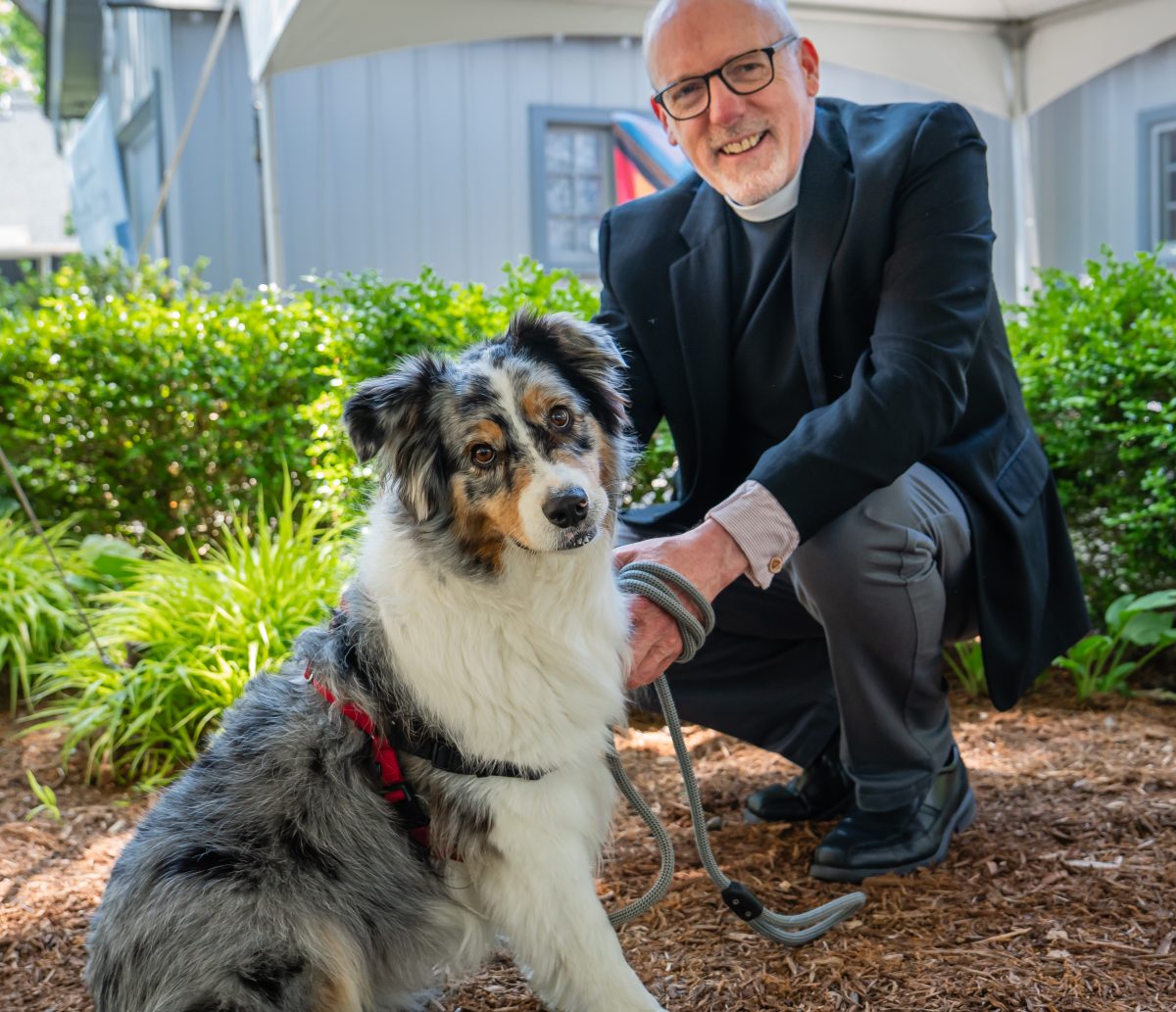
Contrary to most pop culture depictions, Francis of Assisi was not primarily interested in cultivating cozy relationships with other animals. There’s nothing wrong with those relationships—I enjoy one right now with an Australian shepherd dog named River. But Francis devoted his attention to the larger horizon on which such wonderful creatures of God reside. 

What the world needs from the church today is mostly what the twelfth-century world of Francis also needed: a voice for the voiceless; solidarity with the abandoned; healing among the wounded; and justice for the oppressed and exploited.

Of course, the voiceless, abandoned, wounded, and exploited ones include not only other humans but also other-than-human animals. As Francis would also tell us, sometimes the only way to understand what this world needs is by paying attention to the other species with whom we share this planet.

“St. Francis of Assisi,” Kevin Pawlowkski

The complexity and also challenge Francis presents today came vividly to light when I stumbled upon a beautiful though also rather haunting image of Francis by visual artist Kevin Pawlowski. Notice the bird on his shoulder, near his ear (signifying a posture of listening to creation), and the dog in his arms (symbolizing loyalty between different species), and also the stone wall, the cross, and the subtle marks of crucifixion on the hands of Francis himself.

This is not the typical symbol set most people associate with Francis of Assisi, so a few notes about his life might bear rehearsing. We might recall that Francis was born into a very wealthy family in medieval Italy—his father was a silk merchant and his mother was from French nobility.

Francis was never entirely comfortable being comfortable; over the course of his life he grew increasingly unable to reconcile the wealth of some with the abject poverty of so many others. A familiar story from his life illustrates this very point: when he happened upon a beggar in the street, he was moved with such pity that Francis gave him all the money he had with him and even the cloak on his back.

Gestures like that enraged his wealthy father, of course, until finally Francis simply renounced his family’s wealth, his family’s estate, even the family name. He did this rather dramatically, in the middle of the town square where he stripped naked. From that day on, as he would say, he was married to “Lady Poverty.”

Disgusted equally with the opulence of the parish church in Assisi, Francis hiked out to the countryside, to a dilapidated and crumbling chapel in San Damiano. There, as the story goes, a crucifix with the suffering Christ on it, spoke to him. “Francis,” the voice said, “Francis, repair my church!”

San Damiano Cross

So, Francis began dutifully rebuilding that chapel, by hand, one stone at a time, while also preaching to the peasants living in that valley (the “working poor,” as we would call them today, a population that the institutional church at that time had simply abandoned). He also began ministering and eventually living among those with leprosy—shockingly, both then and today, he not only embraced but also kissed many of those lepers as symbols of that same suffering Jesus who had spoken to him from the cross.

How in the world did someone born into such privilege and comfort decide to set all of that aside? Stories of his life offer a number of possible reasons for this, including suffering from a severe illness, engaging in disturbing service in the military, and having more than one vision in a powerful dream.

Here’s what I think, which of course occurred to along the “arts coast” of Michigan, where I currently live: I think heart-rending beauty changed the course of his life.

As strange as that may sound, there is a subtle thread of this running in the Bible and historical Christian traditions, this sense of the life-changing ache in beauty.

I’m not talking about beauty as merely “decoration” or “adornment.” I mean the kind of enticing beauty shimmering throughout what God creates—from mountains and rivers to birds and bears, sky and forests—a beauty the mystics would say awakens our yearning for communion and consummation…or whatever better words we might find for this longing that  mostly defies our ability to speak.

“Ache” and “yearning” work for this, the mystics would say, because this kind of beauty feels like the absence of a lover.

Back in the second century, a Greek theologian by the name of Origen described the human soul as being naturally attracted to divine splendor; the soul is drawn to such heavenly beauty and then falls in love, receiving what he called the dart or wound of love.

Origen seems to suggest a piercing quality in divine beauty, piercing us with a longing for what will finally satisfy what we cannot name. Francis was keenly aware of this elusive desire, and even more keen to denounce our fruitless scramble to acquire all the things and stuff and wealth that have nothing whatsoever to do with it. The pierce of Beauty urges us ever onward—not superficially, or temporarily, or greedily—but genuinely and fully toward whatever “it” is that will satisfy our deepest yearning.

Right there, that’s what the world truly needs: hearts broken open by compassion and empathy; hearts capable of seeing and attending to the pain of others; hearts with the capacity to give nothing less than everything for the sake of life, for thriving, flourishing life—all this would be an offering for the truly beautiful, an offering which is Beauty itself.

And that is what Francis heard in the voice from the cross and also toward the end of his own life. Much like St. Paul wrote about in his letter to the Galatians (a passage that some lectionaries assign for the Feast of St. Francis) apparently Francis received his own set of bodily “marks,” the wounds of that cross on his own body, on his hands and feet and even his torso.

The pierced body of Jesus was for Francis the image of God’s own pierced heart, broken open by the beauty of the world and for the sake of life.

“Repair my church, Francis.”

That voice was not referring to a building, and Francis eventually realized his mistake. Rather than a building, that voice was referring to the purpose of the church in need of repair—the Church is not meant to accrue wealth to itself but to give itself away, for love, for life, for beauty.

I love welcoming companions of other species into worship with humans when we celebrate Francis. And Francis himself would whole-heartedly endorse the presence of other-than-human companions in the sanctuary—especially if the beauty of their intimacy with us breaks open our hearts, pushes the boundaries of our hearts ever outward, extending the reach of our compassion still further toward the despairing and the lost and forgotten.

In the parish where I am privileged to serve as the rector, we practice an “open table” posture toward the Eucharist: everyone is welcome at the Table, no exceptions. And I believe Francis, who was thoroughly devoted to the Eucharist, would remind us that such an invitation is only a foretaste of what is yet to come.

His Eucharistic devotion invites all of us to imagine a world where not a single living being is excluded from the blessings of divine life, not a single one, no exceptions—and that’s a beautiful thing.

“St. Francis Mandela,” Giuliana Francesca

Think like a Mountain

Mid-twentieth century French novelist René Daumal imagined mountains as bridges between the profane and the sacred. In the world’s great mythological stories, he noted, a mountain creates a bond between Earth and Sky; its summit stretches toward eternity and its base spreads out among the foothills in the world of mortals.

In nearly every religious tradition, mountains have become symbols of divine presence. It matters that we have to exert energy to climb a mountain. It matters that we can fall off a mountain and die. And it matters that so many people today still refer to intense spiritual moments as “mountaintop experiences.”

The image of a mountain is never a neat and tidy religious symbol. It stands for all the messy entanglements of the divine and the human in our endlessly complex lives, and the rich texture of life itself, including the mysteries of death. 

“Mt. Temple,” Brandy Saturley and Gisa Mayer

For all of these reasons, the Season of Creation featured this image this past Sunday and also assigned an astonishing reading from the prophet Isaiah (65:17-25), a reading in which we learn something about God by learning something about God’s holy mountain.

In Isaiah’s vision, humans treat each other unfairly and even violently because that’s how humans treat the wider world of God’s creation. On God’s Holy Mountain, the injustice among humans will be remedied because the injustice we inflict on the world of nature will be remedied—one because of the other.


This profound and unsettling connection between the world of humans and the world of other animals occurs multiple times in Isaiah, and always on God’s Holy Mountain: there, peace with justice among human beings will appear first among wolves and lambs, and among lions and cattle, and also between the calf and the bear. And a little child, Isaiah says, shall lead all of them into God’s own realm of thriving life.

I am sorely tempted to embrace this prophetic passage with every ounce of sentimentality I’ve got, and that would be a big mistake. This is not a sentimental image from Isaiah, and it should not feel cozy. Isaiah’s vision is one of profound transformation that leaves nothing untouched—even the most basic elements of how we expect the world to work will change.

“Holy Mountain, X,” Richard Heys

Walter Brueggemann, one of the leading modern scholars of the Hebrew Bible, admits that Isaiah’s vision of God’s Holy Mountain is so “overwhelming” that even he is “at a loss to know how to interpret adequately [this] majestic scenario.”

The astonishing vision of this ancient prophet continues to pose an urgent question today, as it does for every generation: How should we then live if Isaiah’s vision is what God intends for God’s own creation?

A question like that is a reminder that prophets are not particularly interested in predicting a far-off future; they are far more concerned with how we live in the present. How the world will one day be, in other words, ought to shape the way we live now.

That reminder might help us read the longer version of the final chapter in Mark’s Gospel (16:14-18), which this season also assigned for “Mountain Sunday.” Most biblical scholars treat this extended account of the resurrection of Jesus as a later addition to Mark; for some, that’s reason enough to ignore it. But what shame that would be! If we just skip over these verses as just not “originalist” enough, we might miss a key insight about early Christianity.

We could recall, after all, that all four accounts of the Gospel blend stories and sayings and traditions about Jesus, each of them a kind of mashup of various sources, including first-century Judaism. The Judeans at that time held closely to an image of what some have called “the cosmic mountain” to which all nations would one day be drawn and where God would remake the heavens and the earth—and this was especially compelling after the Romans destroyed the temple in Jerusalem.

Early Christians adopted and adapted that image, which is still lingering around the scene from Mark in which the risen Jesus—the one the Romans had crucified, the one God then raised from the dead—when that Jesus instructs his closest friends to preach good news to the “whole creation.”

That phrase in Greek could be translated as preaching to “every creature” or even “every created thing.” So we have here a trace from the first century of Christian faith of a remarkably expansive vision, a claim about just how far God’s new life will reach—and it’s nothing short of everywhere, and among all creatures, and for all created things.

How then should we live in the light of this “good news”? What does it mean for us to live as messengers of this new life for this entire, precious Earth?

How should we then live?

To live as Gospel messengers, we must “think like a mountain”—that’s a wonderful phrase from Aldo Leopold, who propelled modern environmentalism into a new chapter with his 1949 book: A Sand County Almanac. That book inspired a whole generation to think differently about the land, and the importance of cultivating what Leopold called a “land ethic.” (A short overview of Leopold’s “land ethic” can be found on YouTube here, and you can also go here for more on his “thinking like a mountain.”)

We must stop thinking of the land, he wrote, as a commodity we own and instead think of the land as a community to which we belong. We must “think like a mountain”— never for short-term gain, the cost of which is almost always destruction and death, but instead for the longest term possible, for the lifespan of a mountain, for the sake of life.

Leopold lost a lot of friends and colleagues because of his “land ethic.” As he noted rather poignantly in the early 1940s, “one of the penalties of an ecological education is that one lives alone in a world of wounds.”

This, it seems to me, is also the risk of theological education. Gospel witness can be lonely; sometimes our religious commitments will put us in conflict with our neighbors, and with friends and family. Sometimes our vital convictions call into question what the wider society around us just takes for granted—we might be viewed as odd, eccentric, or even a threat.

I think this tension will become increasingly evident as Christians draw from images like Isaiah’s for our shared work of ecological healing. Promoting the kind of transformation the human world now needs so that the world of God’s creation can thrive will certainly not make us popular, and likely all the more alone in a world of wounds.

This is one of the best reasons to keep gathering with others for table fellowship every Sunday morning. This quirky passage from “late Mark” includes a reference to this as well, to a shared meal, which is yet another significant feature of first-century Christian faith. Very early in church history, Christians expected to encounter the risen Christ at the Table, whose Easter life with them would shape their life together.

At the Table, we join a community devoted to the God of life, we gather with people who are trying their best to follow the God of new life, and we’re hoping to catch a glimpse once again of God’s Holy Mountain—a vision of transformed life to inspire and sustain us.

And when this work becomes more challenging and grows more costly, we can return again to the great eighth chapter of Paul’s Letter to the Romans, another rich passage for “Mountain Sunday.”

I, for one, need to hold fast to Paul’s astonishing confidence in that chapter: nothing, absolutely nothing can separate us from the love of God, not ever. And this is the very same chapter in which he describes the “groaning of God’s creation.”

This counts as astonishing, too: the whole wide world of God’s amazing creation actually groans in eager anticipation, waiting for our transformation, for our liberation, for our conversion to life at last.

It won’t make us popular, but God is calling us to live as witnesses to that new life now—and there are plenty of other-than-human creatures who would be terribly grateful if we did that today.

“The Whole Creation Groans,” Claudio Rossetti

Red Sky at Morning

The wider world of God’s creation isn’t always a cozy place. The biblical texts assigned for the third week in the Season of Creation offer a stark reminder that we’re dealing with a bit more in this season than just a soothing tableau of endearing animals or even a beautiful painting of a static landscape we can admire from a distance.

We are embedded in this world, a world alive with the presence of God—a world to which we can, and must pay very close attention.

Crewing a tall ship on my days off I’ve learned from the ship’s captain what it means to attend carefully to one’s surroundings, not only what’s happening on deck, among the passengers, or with the sails, but also out on the distant horizon where storm clouds might suddenly sprout. On the Great Lakes, storms can form quickly and move rapidly and take careless sailors by surprise.

The third Sunday of the Season of Creation features the sky, and everything in it—sun, moon, and stars, as well as the clouds, which can sometimes paint the sky with multi-colored cotton balls and sometimes darken the sky with portents of disaster.

“Creation Sky,” Simone Thomson

The old maritime adage would serve us well this week: red sky at night, sailors’ delight; red sky at morning, sailors take warning. Matthew’s Jesus actually quotes that old adage (Mt 16:2), and he does so to berate his own religious leaders for failing to read the signs of the times properly. James Gustave Speth urged modern readers to do that very thing back in 1980, and even more directly concerning the signs of the environmental times. His book—Red Sky at Morning: American and the Crisis of the Global Environment—was Speth’s attempt to ring the collective alarm bell about climate change. He also was a co-founder of the Natural Resources Defense Council, and his warnings have gone mostly unheeded.

In this world alive with the presence of Creator God, the skies, the land and sea, humans, and all the other animals are all interconnected, all of them offering signs that we must learn how to read.

To modern Western ears, paying that kind of careful attention to the world of nature can sound rather unsophisticated, certainly not very “scientific.” And yet, many environmental scientists today—stretching back to Speth’s work and earlier—sound very much like biblical writers from many centuries ago as they urge us to wake up and pay attention to the living world around us, a world in which we are inextricably ensconced. It’s from Earth that we learn the most about divine blessings as well as judgment.

The ancient Hebrew prophets repeatedly exhorted their readers to notice what Earth and sky might be telling them about how they were living, and especially about the judgment they were bringing on themselves by their own misguided actions.

The seasonal lectionary this past Sunday gave us a startling passage along those very lines from Jeremiah, a passage not only bleak but brutal (4:23-28). After the people of Judea, in stubborn arrogance, refused to heed his warnings about impending war and an invading army, Jeremiah writes as if he is the sole survivor of a catastrophe, the devastating effects of which are inscribed on the land itself.

He describes the shocking extent of this devastation as mountains quake, and hills are torn apart, and farmland turns into desert.

“I saw the earth,” he writes, “and, look, welter and waste…”

That’s the very same Hebrew phrase (from Robert Alter’s translation) that lectionary gave us two weeks ago in the first verse of Genesis, when God created the heavens and the earth. Jeremiah quotes that story verbatim twice more in this week’s short passage, suggesting a terrifying reversal of God’s creative work—the creation itself is unraveling, reverting back to its original chaos.

In Genesis, God looks on each day of creation and calls it good.
Jeremiah looks on each stage of earth’s destruction with horror.

Jeremiah is not enumerating only metaphorical devastations. The intensity of human violence and warfare always and quite literally disfigures the heavens—just as the intensity of human violence against the planet renders the air unbreathable. Thick smoke obscures the skies, the stench of spilled blood and death chokes all those still living, and even all the birds of the air flee.

Silence accompanies the darkness in a bird-less sky, as Jeremiah portrays the desolation of earth, as if the sky is speechless with grief over the wreckage wrought by human violence—just as Mark also portrays a bleak and somber sky as Jesus dies in that portion of the Gospel for this past Sunday (15:33-39).

The descent of darkness in Mark’s account of the crucifixion frames dramatically the heartbreaking journey Jesus is taking into every greater isolation—his own religious leaders condemn him; his closest friends abandon him; imperial forces torture him; even God seems tragically absent—and the skies refuse to give any light as the heavens enter a time of celestial grief.

Like Matthew and Luke, Mark includes another curious detail in this story: the curtain in the temple, the temple veil is torn in two at the moment when Jesus dies.

We might recall that the tearing or rending of garments was a sign of deep grief and mourning in that society, and still today for many. Pair this with what we can learn from first-century historian Josephus: the temple veil, or the temple’s own garment, as it were, was woven with four distinct colors to represent the four foundational elements of the Universe. God’s creation tore its own holy garment in grief over the death of Jesus.

Yes, these are grim readings. But if we pay attention to the Earth, and especially to the sky, as these same readings note, we can still find a thread of hope. In Psalm 19, also read for this week, the psalmist depicts the skies as having their very own voice. The movement from night to day, the changing of darkness to light is a form of speech. Their voice is not heard in words and yet they speak, and they praise God their maker.

Just as many others in the ancient Mediterranean world imagined the movement of planets and stars creating their own music, the psalmist sings about the skies declaring the very glory of God.

More than this, the psalmist then makes a connection between the divine glory of the skies and the divine glory of the law, the ordinances of God for righteous living, for reviving the faint of heart and giving wisdom with vision—more desirable are these ordinances than fine gold and sweeter by far than honey, the very color of the shining sun.

God’s law for life, for the very sake of life itself, is written into the fabric of God’s creation, and this alone is reason enough for our gladness and joy—even in times of deep distress and debilitating darkness.

This is what Paul is writing about in the portion assigned from his letter to the Philippians (2:14-18). Paul is in prison as he writes this letter, and the Philippians themselves have been suffering and undergoing persecution. Even so, he says, hold out the words of life to a world that has lost its way. Live like shining stars, he says, in the darkest of nights.

Do this remembering that God is faithful. Even Jeremiah holds out hope that God’s faithfulness will not permit the utter destruction of Earth. Only by holding fast to this hope can we act for the sake of life, holding out believable words of life for a world that has lost its way.

“Heavenly Sky,” Neelan Kanda

God is faithful. That’s the only reason Jeremiah would even bother to prophesy at all. Bleak and brutal as his text can be, he rants precisely because the people have forgotten what will not change: divine faithfulness. And this is likewise the only reason Paul would ever bother to embrace a life of gladness and joy.

God is faithful. The Church must declare this like we believe it; and then live it as if it matters—because it does, now more than ever.

In our believing and from our living we must offer the words of life for the healing of the world, for a world that has lost its way. Then we will shine like the stars at night.

Made to Set Others Free: The Image of God in the Community of Creation

Crown of creation or apex predator?
Endowed with dominion or called to service?
Forged in a divine image or descended from apes?

What is the human animal, anyway? Must we choose only one of the foregoing images? Some combination of those images? None of the above? 

For millennia, poets and mystics, philosophers and scientists have struggled to articulate what it means to be human. Among the countless proposals, no consensus of any kind has emerged on this question, including among religious traditions and theologians. Even biblical writers do not answer this question directly, and one could construct multiple points of view about humanity using various biblical passages.

“Humanity” is the theme for the second Sunday of the Season of Creation in this year’s lectionary cycle, which we observed yesterday. And even though biblical books represent a wide array of perspectives, those books do seem to offer a singular note of caution about this theme: whatever it means to be human cannot be isolated from the rest of God’s creation.

This is a cautionary note because separating ourselves from the rest of God’s creation is precisely what makes us stumble into arrogance and fall into tragedy—we might recall that the so-called “fall” of humanity in the third chapter of Genesis is mostly a falling away from intimacy, and relationship, and communion.

Embracing the essential and non-negotiable social character of humanity has always been challenging for our species, but especially so in modern Western society. Nearly everything from public school curricula to advertising and popular entertainment trains us to aim always for self-sufficiency as one of our primary virtues—but this is entirely delusional. Every single breath we take relies on the trees growing from the soil and the algae blooming in the oceans to provide the oxygen for our breathing.

“Seven Days of Creation, II,” Sushobha Jenner

No one is self-sufficient, not one single creature of God in what Roman Catholic and feminist theologian Elizabeth Johnson calls the “community of creation.” All life on this planet—all of it—is interdependent.

The lectionary last week featured the ancient story of creation from Genesis, except for the creation of humanity, which the lectionary assigns for this week (Genesis 1:26-28). I think that’s a helpful strategy, a way to underscore that the wider world of God’s creation is clearly good without us. But splitting up the story that way also comes with significant risk—we risk perpetuating a deadly isolation from the rest of God’s creation.

Let’s be sure to note that we humans don’t even have our own day in the creation story from Genesis; we’re created on the same day as all the other mammals—the “cattle and crawling things and wild beasts”—and I note this not to denigrate our humanity, as if threads of relationship diminish us; to the contrary, being woven into the vast web of creation with all other animals is a thing of startling beauty.

The beauty itself evokes, it seems to me, the deep communion for which we all yearn, even when we can’t quite name it that way. Biblical writers often evoke this sense of an ancient wound with which all of us live, and for which only communion can offer healing.

Author Kate Forster writes about all this in the frame of consolation, which she invites by paying attention to the wider world of animals—“consolation” because the notion that we reside at the top of the animal heap leaves us precariously alone.

“I think it’s a deep consolation,” Forster writes, “to know that spiders dream, that monkeys tease predators, that dolphins have accents, that lions can be scared silly by a lone mongoose, that otters hold hands, and ants bury their dead.”

We aren’t speaking about “their life and our life,” she says, “nor your life and my life.” No, there is only “just one teetering and endless thread” of life, “and all of us are entangled with it as deep as entanglement goes.”

I love that phrase, and I think it summons a poignant beauty from Paul’s letter to the Philippians, also assigned for the second week of this season (2:1-8). “As deep as entanglement goes” is also where God has gone in Jesus, and where we still encounter that divine presence in all the entanglements of life itself.

Paul is apparently quoting from an ancient hymn of praise to Christ in this portion from his letter, a hymn of praise for the Jesus who lives a fully human life—going all the way to the cross and tomb, as “deep as entanglement goes”— and by doing so, shows us God with us.

Early in Christian traditions theologians argued that Jesus saves humanity by showing us what it means to be truly human. Hearing stories about Jesus, we catch a glimpse of what it means to act humanly, what it means to live in authentically human relationships, what it looks like for the fully human person to thrive and flourish—free at last from the shackles of bitter resentments and the cycles of violent retributions.

All four Gospel writers grapple with this notion of a divine humanity by using a title for Jesus that we usually see translated as the “Son of Man.” This strange title has a long history in the Hebrew Bible, where some prophets will refer to themselves as “Son of Man” as a way to underscore their own humanity, without any prestige, just an ordinary person like anyone else. For other biblical writers, it’s a title of divine authority, for one who is designated by God to represent who God is.

Both of those meanings merge in the indigenous translation of the Christian Testament, The First Nations Version. In the lectionary passages for this day, that version renders that ancient title as “The True Human Being.”

Mark’s Jesus (10:41-45) describes imperial rulers as those who “show their power over people and push them around.” But this will not be so for those who follow me, Jesus says, for those who live like “The True Human Being” in humble service.

“Imago Dei,” Ndubisi Okoye

Standing in that long line of Hebrew prophets, Gospel writers present Jesus as the truly human one who lives with divine authority. Just imagine what this might imply for the claim that we humans are created in the “image of God,” as the short but galvanizing portion from Genesis declares, an image that remains stubbornly undefined, not only in Genesis but in the rest of the Bible.

Isn’t time—way past time, actually—for us humans to stop assuming that the divine image grants us godlike power to dominate other humans and subjugate all other animals. And why is “godlike” even associated with “domination” at all? How might the world change if instead of a swaggering coercion, God’s image is instead a posture of humble service that sets God’s creatures free?

Quite honestly, that very possibility slapped me awake like a clap of heavenly thunder as I tried to preach on these texts. Reconfiguring the divine image would surely shift dramatically how that short portion from the very first chapter of the Bible is usually read, especially when Creator God gives humanity “dominion” over all the other animals.

The history of that little phrase is ghastly and horrific—which is putting the matter quite modestly—not least because that sense of dominion has too often applied to particular humans who are counted among those “other animals.”

Lurking around in that troubling word “dominion” is of course the Latin word for “lord”—dominus. Strikingly—and I mean this ought to jolt us all awake—the Gospel writers and Paul insist that that the “dominion of the dominus,” the power of the Lord Jesus, appears most vividly in humble service to others—to all other creatures of the same God.

Now is the time to define these powerful biblical words that have remained so despairingly vulnerable to distortion and even torturous manipulation; Earth herself is crying out for this religious intervention, and this is it: To “have dominion” is to serve others and to set them free; this is the very image of God, and the only definition that matters for what it means to be human.

A Re-enchanted Earth

And it was good.
And it was good.
And it was good.

This is of course the repeated refrain from the ancient story of creation in the very first chapter of the Bible—the Bible begins with goodness.

It’s worth noticing in this story that Creator God declares the light and the waters and the land and the beasts and fish and birds—all of it—as good long before humans ever appear.

Earth herself is good, quite apart from whether or not it is good for us.

Believing that Earth has its own intrinsic value would surely shift how most of us humans think about our place and our role in the wider world of God’s creation.

Devoting time and energy to such questions is one of the reasons I have grown to love The Season of Creation, a mini-liturgical season that has developed over the last thirty years or so and is now celebrated among Roman Catholics, Anglicans, Eastern Orthodox Christians, and many others in the month of September.

This little season has its own three-year lectionary replete with weekly themes and images. The first Sunday of this year’s cycle, which we celebrated just yesterday here in Saugatuck, was devoted to Earth. to the goodness of Earth, which is paired closely with the goodness of God in the ancient story from Genesis; creation and creator together are good—full stop, no conditions, no caveats.

“Beauty of Earth,” Chhaya Dubey

This emphasis on goodness matters, culturally and politically and not only religiously. Or perhaps a better way to say that: the religious significance of this story from Genesis appears most vividly in its cultural and political consequences.

Early Christian theologians, for example, used this story to destabilize the oppressive power of the Roman Empire, which is certainly a counter-intuitive use of a biblical text. The line of reasoning ran something like this: compared to the God who creates all there is out of nothing, Rome is certainly not eternal.

Equally intriguing is to notice where, when, and why this ancient story was first written. Most scholars date this story to the period of the Babylonian exile of ancient Israel, when Babylon invaded Judah, occupied Jerusalem, and took her people into captivity.

This was an unmitigated disaster for God’s people, and in that time of crisis, exiled from the land God had promised to give to them, it’s at least curious if not terribly odd to devote one’s energy to telling a creation story. The reasoning here ran like this: the Creator God who brings order out of turbulence will surely restore order to God’s people living in the chaos of exile.

Empires come and go, in other words, kingdoms rise and fall, and yet through all of that chaos—all of that “welter and waste” as Robert Alter’s translation would have it—Creator God brings forth order, harmony, and beauty.

“Earth Healing,” Gaia Orion

Naming and living the significance of this story today presents a different kind of challenge, and in some ways for a much more severe crisis. We modern humans have, in effect, exiled ourselves from the goodness of Earth in the midst of an ecological crisis our ancestors never could have imagined.

Today’s crisis, the challenge of living in the spiral of a collapsing network of ecosystems, pushed me to pay closer attention to the lectionary choices yesterday—and I stumbled into an insight from those texts I hadn’t seen before.

For some years now, I have relished reading the first chapter of Genesis together with the first chapter of John’s account of the Gospel. As some scholars have suggested, John is basically early Christian commentary on Genesis—the first verse in both books is the same: “In the beginning…”

But here’s what I haven’t considered before: John seems to invite us into the inner life of Earth, where the creative Word of God shimmers with divine energy, that Word who was with God from all eternity, and who dwells with us in the flesh (John 1:1-14).

It occurred to me, in other words, that John might be inviting us to notice an “inside” and an “outside” to God’s creation. As strange as that sounds, we do sometimes speak that way about ourselves. Each of us has an inner life, most of which is usually known only to ourselves or perhaps an intimate partner, and also an outer, visible life seen by others.

The failure to think that way about the wider world of God’s creation, about this “inner life” for Earth, is likely at the root of today’s ecological crisis. Modern human societies have treated Earth mostly like a giant rock floating in an empty space—the “third rock from the sun”!—rather than a living organism, brimming with life itself, and with the very Word of God as her heart and soul.

Meanwhile, modern industry and the burning of fossil fuels have exacerbated what is actually an ancient problem. Yesterday’s lectionary described that problem in a passage from the first chapter of Paul’s Letter to the Romans (1:18-25): God’s invisible Spirit has been clearly shown through the visible things God has made, Paul says; but human beings have not honored that Spirit.

We’re using the First Nations Version of the Christian Testament of the Bible in this season, and in that version of Paul’s letter, the “failure” to give God proper thanks is referred to as an “empty way of thinking,” which has taken hold of our “foolish hearts”—a powerful reminder, it seems to me, of mind and heart intertwined, connecting what we think and how we feel for the way we act.

Reading from this version of the Christian Testament can remind us that our indigenous neighbors think and feel differently about Earth—about the land, other animals, about sea and sky. Much like St. Francis of Assisi, actually, indigenous communities treat everything around us as living beings. Francis famously sang the praises of “Brother Sun and Sister Moon,” of “Brother Wind and Sister Water,” and of course Mother Earth, who “sustains and governs us.”

This respectful posture of loving relationship—rooted in both indigenous and Christian traditions—certainly seems at odds with our frequent dredging, stripping, drilling, fracking, and burning of Earth, our mother.

In the late nineteenth century, the German ethicist Max Weber sounded a note of severe caution about Western society. He worried that certain strands of the Protestant Reformation had basically “evacuated God from Earth” to reside only in Heaven. This leaves Earth, as Weber put it, a “disenchanted place,” simply a giant warehouse of stuff for us to use however we wish.

Against that grim backdrop is John’s luminous vision of God’s very own Word creating and animating the whole world, enchanting it with divine presence—and this, we might dare to suppose, this re-enchantment of Earth, might very well be a lifeline of hope.

Despair is easier, especially since it is now perfectly clear that we as a species and a global community lack the political will to address climate change effectively, Indeed, many environmental scientists are publishing plans for how we now need to re-orient our lives and adapt to what is now inevitable: seriously harsher living conditions on this planet because of a swiftly changing climate.

“Adaptation” sounds modest and doable; but the kind of adaptation we need to consider is actually quite dramatic and, as many scientists worry, our species may not be up to the task. I truly believe this is precisely what religious communities of vibrant spiritual practice are for. Adapting in the ways we now must, it seems to me, will be possible only if we embrace Earth herself as alive with the presence of God.

A re-enchanted Earth would re-shape what all of us think and how all of us feel for a different way to live.

And still more: a re-enchanted Earth would renew us with hope, perhaps even inspire us with joy, and move at least some of us to dance for the resilient goodness of Earth herself.

I would say yet more about Christian worship: a re-enchanted Earth is precisely why Christians should bother to gather around the Eucharistic Table every week, where God offers God’s own self to us in love, as bread and wine, with grain from the soil and grapes from the vine—this is my body, Jesus says, this is my blood: the very Word of God in the stuff of Earth.

And it was good.
And it was good.
And it is very good…

“Brother Francis and the Canticle of Creation,” Nancy Earle

That Nothing May be Lost

“Eucharist” is one of those arcane religious words I wish more people could embrace for their own healing and thriving, and in turn for a better world. The word comes from a Greek verb for “giving thanks,” and it refers to what is more commonly called “The Lord’s Supper” or “Holy Communion.” And I really do believe it can change the world.

I believe the Eucharist is at the very heart of the Gospel and is the very soul of the Christian Church for the sake of the world’s flourishing. The Eucharistic Table offers us God’s love and grace in Christ with tangible tokens of bread and wine—food for the journey into new life.

Given all that, I find it very strange indeed that the Gospel according to John has no Eucharistic narrative in it—or rather, nothing most Christians would immediately recognize as precisely that narrative.

What most Christians take “Eucharist” to mean is due in large measure to Matthew, Mark, and Luke. Those other Gospel writers give us the “last supper” where Jesus talks about bread as his body and wine as his blood. That’s what most of us look for when we’re looking for Eucharist, and John doesn’t have it.

But this does not mean that there is no Eucharist in John.

Intriguingly, some scholars have suggested that the entire gospel according to John is one long, extended Eucharistic narrative. The reason we can’t find the Eucharist in John is because the entire Gospel of John itself is Eucharist. Some have also suggested that John was composed precisely for the purpose of reading it during early Christian celebrations of the Eucharist.

“The Feeding of the 5000,” Daniel Bonnell

Yesterday’s lectionary gave us John’s version of the miraculous feeding of the 5,000, which is one of John’s key Eucharistic stories (6:1-21). And the lectionary will continue to give us this image for the whole month of August, returning again and again to the image of bread and therefore to the Eucharist.

Rather than betrayal, suffering, and death (what most Christians associate with the “last supper” narratives), John frames the Eucharist with divine abundance and divine inclusion. And this matters far more than we usually imagine for a fragmented world in pain. I would say the stakes could not be higher in that regard when reading from this sixth chapter of John.

I find it helpful to remember that the disciples are never just the disciples in Gospel stories; they serve as types and symbols—sometimes for the realist, or the doubter, or the loyalist, or the betrayer.

First, then, we might note that in this iconic story from John the disciples stand for all those who worry about scarcity. Jesus looks out at the crowds who had been following him all around the Galilean shoreline, and he says, “these people are hungry.”

“Well, yeah,” the disciples say, “but where are we going to buy enough bread for all these people? What we have isn’t even enough for us!”

To be clear, the disciples were not wrong in what they said; they assessed the situation correctly—they did not have enough.

But where we see scarcity, John invites us to see God’s abundance.

Of course that’s a lot easier to say than it is to live. In fact, most economic systems in human history have been built on the fear of scarcity and the anxiety that there won’t be enough of what we need—not enough water, not enough bread, not enough love, not enough respect or dignity.

There will always be certain individuals and organizations who capitalize on that fear and anxiety, usually by dividing communities into groups—those who have supposedly earned what little there is, and others who haven’t. More severely, by demonizing others who threaten to take away what little is left. The fear of scarcity often turns violent.

“Feeding of the 5000,” Magalona Justino

John’s miraculous feeding of the 5,000 is a Eucharistic story of abundance. There is always more than enough love, more than enough grace, more than enough companionship at the Table to satisfy our deepest longings.

We might also remember that there are no random or insignificant details in these Gospel stories. After feeding the crowds with what little they had, there is more leftover. How much more? Not eleven, and not thirteen, but exactly twelve baskets of leftovers.

Just as there are twelve tribes of ancient Israel, and just as there are twelve disciples, so there are twelve baskets of leftovers.

“Gather up the fragments,” Jesus says, “so that nothing will be lost.”

Nothing? Not one single tribe? Not one single disciple, not even Judas?

In today’s world of zero-sum games, there must be losers in order to have any winners and our triumph rises up only from the wreckage of the tragedy of others. But that is not the world of John’s Gospel where Eucharistic abundance is so pervasive and so comprehensive that nothing, absolutely nothing and no one is left behind. 

John invites us to catch a glimpse of God’s own heart in this story, where no one is lost, and no one is left behind. The implications of this story for how we live and the kind of communities we create are actually quite staggering.

It’s nearly impossible to imagine a world where we no longer keep score; where constant contests give way to communion and “fairness” doesn’t matter nearly as much as inclusion; a world where there is no such thing as “acceptable losses” and “collateral damage” is a forgotten notion from a far distant past.

Many Gospel parables evoke exactly this unimaginable world, and John’s Jesus underscores that vision by remaking entirely what it means to “win”: it means not leaving any one behind—not a single one, not even the betrayer.

This vision is so difficult to trust that other parts of the New Testament—even other parts of John—seem to step back from it. And today, many centuries later, the Eucharist—or rather the last supper—continues to be a flashpoint for cultural controversy. The latest example just occurred at the summer Olympics in Paris where the opening ceremony included what appeared to be a parody of the last supper with drag queens.

A variety clergy and churches demanding an apology for that performance, I think we Christians should instead be thanking the performers. Not only is a drag queen last supper not offensive, it might actually illustrate John’s Eucharistic vision better than most Christian liturgies—not only is everyone invited to the Table, we are invited to leave no part of ourselves behind. All of us and our whole selves belong at the Table.

I love John for retaining and preserving at least this kernel, this seed of a truly radical Jesus who shows us a truly unbelievable God—the God for whom even one is an unacceptable loss. If God cannot tolerate losing even one, then even if it takes an eternity, God will find them.

So much is arrayed against that vision in a world built on scarcity and exclusion. That’s one of the primary reasons why I practice what is often called an “open table” policy in the parish where I’m privileged to serve as the rector.

At All Saints’ Parish in Saugatuck, Michigan, there are no preconditions for participating in the Eucharistic Communion. Everyone is welcome—no exceptions, no caveats, no kidding. Nothing is required to receive Communion at the All Saints’ Table other than one’s own desire for Communion—because God loves each and all of us without limit. Nothing we can do can make God love us more than God already does, who has given God’s own self to us already. And nothing we can do can make God stop loving us, not ever.

I am convinced that this kind of Table Fellowship can change the world; it offers healing to a world of hurt, and then still more. It offers a Eucharistic vision of a world remade by love and grace where no one is left out—not a single one.

“Gather up the fragments,” Jesus says, “so that nothing may be lost.”

…so that nothing will be lost.

“The Miracle of the Five Loaves and Two Fish,” Carol Bomer