Here’s Mud in Your Eye! Earth Healing for Lent

When the conditions on a racetrack are just right, and when one of the horses is clearly leading the others by at least a good body length or so, the hooves of that lead horse can kick up clumps of dirt and mud, which can land in the faces of the horses trailing behind.

That horse-racing image crept into American taverns in the late nineteenth century as a toast while clinking beer mugs and signaling victory for the speaker: “Here’s mud in your eye!”

Clouded or obscured vision tied to one’s standing in a race is one among many examples of physical sight as way to speak of knowledge or insight. “Oh, I see,” someone might say, referring to nothing in their physical line of sight but rather to their cognitive acuity.

This figure of speech and its many analogues are remarkably widespread, across nearly all cultures. Some have even suggested that eyesight—the physical act of seeing—is the primary way we gather information about the world around us.

(I have to say, I’m not entirely persuaded about the primacy of vision. American philosopher Richard Rorty was fond of pushing against such claims by wondering why seeing something should give us more knowledge about it than, say, rubbing up against it, or hearing it, or embracing it. The obsession with ranking lurks around these possibilities, too, as if we must always identify the best or the only way truly to know something for really real.)

The common contrast between dark and light, between shadow and illumination, likely plays a role here, too: what we truly know has come into the light of day. Nearly all of the world’s religious traditions embrace such contrasts to describe enlightenment and spiritual awareness, and the Lenten lectionary gave us a classic story about this just yesterday, the story from John’s account of the Gospel (9:1-41) about Jesus giving a man born blind the gift of sight.

“Healing of the Blind Man,” Anthony Falbo

Images of light paired with sight create the moment of divine encounter in this story when, as we like to say, “seeing is believing.” John notes directly the spiritual significance of this moment as it becomes entangled with religious regulations. While the gift Jesus offers surely counts as a reason to celebrate, the religious leaders of that man’s community are thoroughly skeptical and even resentful about it.

In fact, this long reading from John’s Gospel is mostly about religious resentment, about a near-comedic refusal of those first-century religious leaders to recognize a moment worthy of shared praise and celebration. John likewise uses images of sight for such religious folly with a reversal of fortune motif: the one born blind, now can see; the ones who should have seen, are now blind.

Full transparency: I’m a religious leader, too. I’m just as complicit in religious foolishness as those first-century figures. I know only too well how easy it is to get so caught up in the gears and gadgets of institutional religious life that we miss the very life-giving presence of God among us—we just can’t see it!

Religion can cloud our vision, but so can patriotism, and nationalism, and ethnicity, and money, and gender. Our social identities and strategies for navigating our relationships can act like blinders, rendering us oblivious to the wider world all around us.

“Wake up!” says the Pauline writer to the Ephesians—another great image for insight and awareness in yesterday’s lectionary texts (5:8-14). Waking up, of course, can happen in a number of ways, including opening one’s eyes and seeing, but also (as Rorty would remind us) touching, listening, showing up, paying attention, living bravely, forming communities of trust, standing in solidarity with the most vulnerable, to name just a few of the many ways we can awaken to God’s presence.

Two weeks ago, the Lenten lectionary gave us Nicodemus at night, under the cover of darkness; last week, the woman at the well in the bright light of day; and now sight for the man born blind: throughout John’s account of the Gospel, Jesus is waking people up, and showing them the truth, and inviting them to walk the good road toward abundant life.

John is also clear about this: traveling that road is risky, and not everyone is happy to see the truth come to light, and seeing truly may well cost us nothing less than everything—this Lenten road leads to the Cross, after all. And let’s not fail to notice that the gift of sight to the man born blind cost him his religious community, his home, his friends, and family.

To “wake up” and begin seeing even hints of the truth can cause us to question where we really belong, and with whom, and for what purpose, and to reject even religion if it offers anything less than thriving, authentic life.

I love the First Nations Version of this story, an indigenous translation our parish enjoys during Lent. In that version, the man born blind asked Jesus to tell him who the Chosen One might be, and Jesus said “look at me”—to the one born blind, he said look at me and see the One chosen to live as the “True Human Being”—woke, compassionate, devoted to healing.

Yes, and, all of that said, why the mud? Seriously, why mud?

Jesus encounters this man born blind, and his first impulse is to spit in the dirt, make mud, and smear it on the man’s eyes? Really? I’m surely not the only one who is just a bit too germ-phobic to relish the idea of having muddy spit on my eyes.

Why would John—supposedly the highly sophisticated, intricately philosophical Gospel writer—why would John include this literally dirty detail? Doesn’t this seem, well, rather primitive and crude, especially by modern Western standards?

Reading this story in the First Nations Version prompted me to reflect a bit more than I usually do on Jesus firmly planted in the land itself—on Jesus, in other words, as indigenous to the land of the Mediterranean basin. He was not only an itinerant preacher and teacher, but also a traditional healer. (A number of insightful thinkers continue to help me bridge my Western Christian convictions and indigenous practices, including Randy Woodley.)

Indigenous healers of all ethnic and cultural backgrounds around the world are typically attuned to what we modern people often call (sometimes dismissively) “natural remedies.” In that light, of course Jesus is rooted in the Earth, the land, and yes, the dirt as he makes mud for a healing salve.

Reading such stories from a gilt-edged, leather-bound book extracts these earthy stories from their natural habitat. We have so sterilized and sanitized and intellectualized these ancient texts that we have all but forgotten their fleshy origins in the land, in the dirt itself, which it turns out has healing properties.

The Latin word for soil is humus; that’s also at the root (as it were) of the word “human.” Dirt is not inert; it brings forth life, and not only our life—the soil itself teems with all sorts of life.

“When the Light Breaks Through,” Catherine Picard Gibbs

The failure to thrive that leads to death happens quickly when we tear apart the bond between human and humus, between creatures of Earth and the soil. That certainly describes today’s ecological crisis, and the deadly consequences of removing ourselves from Earth herself, where—along with the air and water—God’s own Spirit of life resides. (Yet another example of religious blindness is my constant struggle to suppose God resides somewhere “out there,” way beyond the sky, the stars, the edge of the Universe itself; the Spirit of Life, the Source of all living things is instead everywhere around us and in us–and I’m convinced that this conviction alone would change the world.)

These traces of traditional healing practices—and regardless of whether the Johannine writer intended this—evokes the indigenous bonds to the land which we need so desperately to recover today, and suggests what a twenty-first century Lenten practice really ought to entail: repairing our relationship with Earth.

It just so happens that we’re reading this story not only in Lent but also Women’s History Month. So let’s be sure to note how patriarchal systems associate Earth-based traditions with women (and are thus easily dismissed), while text-based traditions belong to men (who hold the power of interpretation and thus authority to decide what is true). More pointedly, feminizing Earth makes her suitable for male control, for ravaging, and for plundering, and for extracting resources whenever we please. This is exactly and literally and not merely metaphorically what Jeffrey Epstein was doing with girls and women on his Island of Misfit Billionaires.

Repairing, it seems to me, likewise means this: refusing to choose between Earth and Text, between healing and knowledge, or indeed between female and male.

Either/or, binary choices are part and parcel of the problem that wounds us, and they are far too limiting in the wonders of a world God has created, not for division and separation but for communion. John’s Jesus is, in every Johannine story, perfectly attuned to the energies of Earth and also to the presence of Creator God; his ministry (and most of the so-called “miracles”) quote often consisted in revealing and disclosing that deep harmony between Earth and Creator for the sake of healing and abundant Life.

That harmony (and the communion it creates) is the precious circle of light into which we are invited to step—or really, urged to step. There’s no time to waste: Let’s step fully into that light and shine as beacons of the Gospel in a grim and violent society, inviting others to wake up with us, not only to see with the heart, but to feel with the soul, and to hear with ears tuned to the rhythms of God’s presence thrumming and vibrating in the loamy soils of Earth.

Jesus spit into the dirt and made mud; Jesus made mud pies, and then he spread them on a blind man’s eyes for the gift of sight: returning to Earth—repairing and healing our relationship with Earth—this will make us shine, just like Jesus, as light for the world.

(And by the way, among the many things such light would illumine—to recall where this blog post began—is hope for horses to live a life free of entertaining humans. Severe suffering often results from their coerced performances, and sometimes dying in horrible pain because of it. The efforts to ban horse-drawn carriages in New York City continue for that reason as Mayor Mamdani indicated his commitment to ending the practice, but opposition to the ban has been fierce. It’s time to invite other species with us into that circle of Gospel light—free of saddles, free of harnesses, free of human domination.)

“Spirit of the Horse,” Gordon Henry (known as a “ledger artist” who used pages from commercial ledgers as “canvas” to create images of vitality of the very natural world that had been reduced to commodities on that paper.)

Queering the Lamb as Shepherd for a Mothering God

My theological education continually confronted me with the claim that theological language is symbolic and analogical. Not just some God-talk, but all of it. Everything we say and try to say about “God” is a symbol (it points toward a reality we cannot grasp directly) or an analogy (a comparison of two things that are not the same but sufficiently so to help us think and communicate).

Most people get this readily enough when they come across biblical texts with images that so clearly rely on common literary tropes: God as a “mother eagle,” for example, who hovers over her nest (Deut. 32:11-12), or describing God as a “fortress,” “rock,” “shield,” and “horn” (Psalm 18:2), or Jesus as the “vine” and his disciples as the “branches” (John 15:1). But the claim about symbolic language applies not only to the obvious examples, but as some theologians have noted, to all theological speech. Even when we declare that “God is love” our experiences of human love fall far short of what divine love is actually all about.

This coming Sunday, as it does every year on the Fourth Sunday of Easter, the lectionary gives us another image from the Gospel according to John. It comes from John’s tenth chapter about Jesus as the “good shepherd.” Also appointed for this very same day is a passage from the last book of the Bible, the Revelation to John (7:9-17), where Jesus is portrayed as the “lamb who was slain”—a lamb who is now not only alive but living at the center of heaven’s throne as a shepherd.

“The Good Shepherd,” Br. Mickey McGrath

Tossing those two readings together on a single Sunday puts “theology-as-symbolic-speech” on steroids. The peculiar pairing of lamb-as-shepherd is just one of many illustrations of what drew me more than 20 years ago to the academic discipline known as “queer theory” in my theological work, and why I felt certain it could provide useful tools for Christian theology.

As queer theorists often want to note, the categorial classification schemes we devise for our identities and relationships—male and female, gay and straight, among so many others—simply fall short, and sometimes hideously short, of how people actually live and who they understand themselves to be. Those categories become tightly sealed boxes, restricting our movements and dictating our behaviors. In that sense, at least for some of these social theorists, to “queer” a category is to scramble its standard definitions, unravel its regulatory certainties, and liberate a whole new set of evocative possibilities from its conceptual prison. Surely this is what John the Divine intended (even if he didn’t think of it this way) when he queered the image of a lamb, the one who had been slain by the Roman Empire, and who now sits enthroned as a heavenly shepherd.

Dealing with the limits of language in texts where the symbols are obviously scrambled is one thing; it’s quite another to loosen one’s grip on religious terms that more truly have their grip on us, as it were. One of the most obvious and highly-charged examples of this is the language of God as “Father.”

That paternal image of God was so deeply embedded in my Christian faith for so many years, I could scarcely imagine a Christian life without it; therein lies the challenge of appreciating the symbolic character of not just some but all theological speech. I find it helpful in that regard to remember the long history of patriarchal societies from which most religious traditions emerged; in those societies, anyone who is “in charge,” or has power, or can make decisions, is almost assuredly male and probably a father. It’s a fairly short step from that social arrangement to configuring “Creator God” as a paternal figure.

But there’s another underlying assumption to notice carefully in that historical development: the analysis I just outlined relies on a notion of God that involves, by definition, someone “being in charge” and “in control.” Power itself needs to be “queered.”

“The Shepherd Woman,” Xhevdet Dada

So I have to wonder: could the annual observance of “Mother’s Day” falling on “Good Shepherd Sunday” in the Easter season help us navigate these quandaries in theological speech? Maybe. But just exchanging one word for another—God the Father is now Mother—won’t take us very far down that road if all the patriarchal power is still in place. What is “power,” anyway? Who wields it? Under what conditions and for what ends? I’m certainly glad my own mother ran our household—my dear old novelist-dad would have made a mess of it. Did power actually reside anywhere in that domestic arrangement, or did it continually circulate throughout our relationships in glimmering gyres of affection and Midwestern practicality?

I’m not paying nearly enough attention to my own power as a white man as I write this (what this blog post needs is a trans-woman of color at the helm), but I am trying to pay attention to the image of the “lamb as shepherd” even as I harbor lovely memories of my mother—as she writes the checks to pay the bills while dad sits at his desk in the basement writing his novels.

It’s at least a bit subversive to suppose that a lamb can function as a shepherd, and by putting a lamb on the heavenly throne at the pinnacle of divine glory John the Divine certainly invites a reassessment of our standard modes of describing divine authority—or rather, that those typical modes just don’t apply. And that’s when I need to get busy and sort out what my own gendered power and privilege.

In the end, we only begin to realize that our job is not somehow to “make sense” of our theological traditions (whatever that may mean) but instead to allow those traditions to invite us ever deeper into the mystery of divine life at the very heart of the Universe—a mystery not merely to marvel at but find ourselves undone by and then changed.

For now—or maybe for always—in this world of so much pain and sorrow, I turn to the queerness of theological speech for comfort. It might lead me still deeper into the heart of the Universe where a rather queer Creator God transcends yet also fulfills everything I had always hoped a “father” and a “mother” might offer: unfailing care and undying love.

Or as John the Divine will invite us to imagine for Good Shepherd Sunday:

“The Lamb at the center of the throne will be their shepherd,
guiding them to springs of the water of life,
and God will wipe away every tear from their eyes.”

“The Good Shepherd,” Jacinta Crowley-Long

Easter—Thanks to Women

It was so wonderful to welcome back “Alleluia” to the liturgy after our Lenten journey without it. Hearing Mark’s account of the resurrection of Jesus yesterday morning, I was also reminded that our Easter Alleluia is possible at all because of women.

As I walked through the painful and poignant moments of Holy Week, anticipating the joy of Sunday morning, I realized in some fresh ways this year that we would gather on that glorious morning of Easter because of women.

All four accounts of the Gospel are very clear about this: women were the first witnesses of the resurrection of Jesus from the dead, and they were also responsible for telling others this good story—they were the very first apostles.

“The Empty Tomb,” He Qi

I had some more personal reasons for this kind of reflection as well: March 31 just happens to be the anniversary of my dear mother’s death, a woman who was faithfully a witness for me—from my earliest days, as far back as I can remember—she was a witness for me to the risen Christ by the way she lived and loved.

How she lived and loved—that’s what makes Easter “real,” how it changes our lives, and our relationships, and our communities.

Scientist and theologian Ilea Delio insists that “love lives in persons,” not ideas or doctrines. “Love is not a concept,” she writes, love is “a powerful, transforming energy that heals, reconciles, unites, and makes whole” (from her marvelous book, The Unbearable Wholeness of Being).

This transforming energy of love makes all things new, reminding us that whatever else “resurrection” may mean, it does not mean “resuscitation.”

The risen Jesus is not a corpse come back to life, nor is he a ghost. As St. Paul put it, the risen Jesus is the first fruits of a new creation (1 Cor. 15:20), a new way to live—and not just Jesus alone, but also the women, who were the first witnesses of the resurrection, they too, along with Jesus, were the first fruits of God’s new creation, a new way to live.

The indirectness, as it were, the obscurity of that first Easter morning, strikes me in very particular ways whenever we hear Mark’s account of it (16:1-8), which is the slimmest and thinnest description of whatever it means to say Jesus rises from the dead.  All four Gospel writers treat the resurrection as utterly mysterious, but not the consequences. There is new life to be lived because of the resurrection of Jesus.

The heart of Easter is not only that Jesus is somehow alive, but also that we are, and that we live differently because of Easter. This is in large measure why, I think, Mark has the women run from the empty tomb in terror and amazement.

Of course these first witnesses to Easter are terrified, not only because God is so clearly at work in that empty tomb but also because of what it means for them and how they must and will live in a brand new way.

Preparing for Easter, I was reminded again of my trip earlier this year to southern Africa, where I met a young man in Johannesburg by the name of Nkululeku. His name in Zulu means freedom.

I devoted some energy this Lent to considering the various ways spiritual disciplines might foster a more vibrant and deeper freedom, and especially the precious freedom Jesus offers from the fear of death. Anxiety over death gets expressed in so many self-destructive habits and corrosive social patterns—from opioid addiction to environmental destruction.

“In the Spirit of Honoring Our Ancestors,” James Jacko

Still further richness for this notion is coming the First Nations Version of the New Testament that we’re using here at All Saints’ Parish this Easter Season, the indigenous translation that presents the Gospel as the “Good Story of Creator Sets Free.”

Weaving all of this together brought to mind my firm conviction about the gendered character of our collective distress as human beings. For many years now, I have been thoroughly convinced that homophobia is rooted in misogyny.

Less abstractly, whatever keeps us enslaved to violence, whether because of race or sexuality or class or even species, has its roots firmly planted in patriarchy, in cultural systems that favor men and masculinity while degrading women and reviling the feminine. Ask nearly any gay man who has experienced taunts, jeers, fists, or rejection—the violence springs from our failure to be “real men.”

It matters—so much more than most usually suppose—it matters in the first-century world of patriarchal domination that women are the first witnesses to the resurrection of Jesus from the dead; the first to see that Jesus himself had been set free from the tomb; the first to experience the exhilarating trepidation of brand new life.

To no small degree, the joy of Easter is in proportion to how clearly we can name the severity of institutional systems of patriarchal domination that hurt women, and children, and men, as well as other animals and whole ecosystems. Imperial patriarchy killed Jesus, after all, and women are the first witnesses to God’s vibrant new life in the world.

Mark’s Jesus most certainly sets us free from the fear of death. Mark makes equally clear that we also need the courage to live this new life free of patriarchal control, and to shape our communities with it, and to imagine entirely new ways to be human on this precious Earth.

That’s how I read that moment in Mark’s account when an angelic figure instructs those first apostles of Easter, those women at the tomb, to go to Galilee. That’s where the disciples of Jesus, including women, first encountered Jesus as “Creator Sets Free.”

And now you must go back there, the angel says, and learn how to live that Easter freedom in your own lives with a fierce courage and with an enduring commitment not merely to resist patriarchal systems but to dismantle them entirely.

The Lenten road of discipline does not end on Easter morning, but from here on, there is no map to follow, no sacred GPS to consult. Our own “Galilee” of new life beckons to us, for which we have no blueprint.

Yes, of course that’s more than a little scary, but we are not on this journey alone. The One who is God’s very own freedom incarnate, and who is divine love in the flesh, lives and travels with us, among us, and in us.

We can rely on this Easter declaration, we can trust it with our lives—because of women.

“Jesus Rises,” Douglas Blanchard

Death is Easier

“Alleluia! Christ is risen!”

We can make that joyous declaration because women were the first witnesses to the resurrection of Jesus from the dead.

Women were the very first apostles of an Easter faith, and we must not take this for granted.

“Empty Tomb,” He Qi

The first-century Mediterranean world was a thoroughly patriarchal society: poor women had no legal rights whatsoever; they were never taught to read or write; and they were considered the property of their husbands.

Even wealthy women—who had only just a tad more freedom—even they could not vote, could not stand for political office, had no formal role in public life, and their testimony could not be admitted into a court of law.

Let us, therefore, note this very carefully: in that thoroughly patriarchal society, all four Gospel writers—most assuredly all of them men—make perfectly clear that women were the very first witnesses of Easter!

Luke takes this storyline still further (24:1-12) by noting rather painfully that the men to whom those women delivered the glorious news did not believe the women, and these men were some of the closest friends of Jesus.

This centering of women in what I would certainly consider the core story of Christian faith is not merely remarkable; it’s a miracle.

I think these Gospel writers are making a theological point by putting women on center-stage in the Easter story. And the point is this: the death-dealing world of patriarchal domination is over. There are lingering effects of that long history of domination, to be sure, some of them quite painful and long-lived, even traumatic. But that world of patriarchal violence will never have the final word; and indeed, concerning new life, women have the very first word.  

Still, I have to wonder: why did those male disciples refuse to believe the women? This should have been the happiest news they had ever heard. Why, in Luke’s words, did it seem to them merely an “idle tale”?

Luke suggests a reason with the question posed to those apostolic women by angels at the empty tomb: Why are you looking for the living among the dead? That’s an important question all of us should be asking ourselves quite regularly: why do we keep returning to worn-out patterns and toxic relationships and lifeless institutions?

Here’s an answer I’ve been sitting with for a while: because death is easier than new life.

Winter’s reluctance to yield to spring here in western Michigan this year reminded me of those cold wintry mornings over the last few months when the alarm goes off and the wind is howling and the snow is blowing and it’s dark outside.

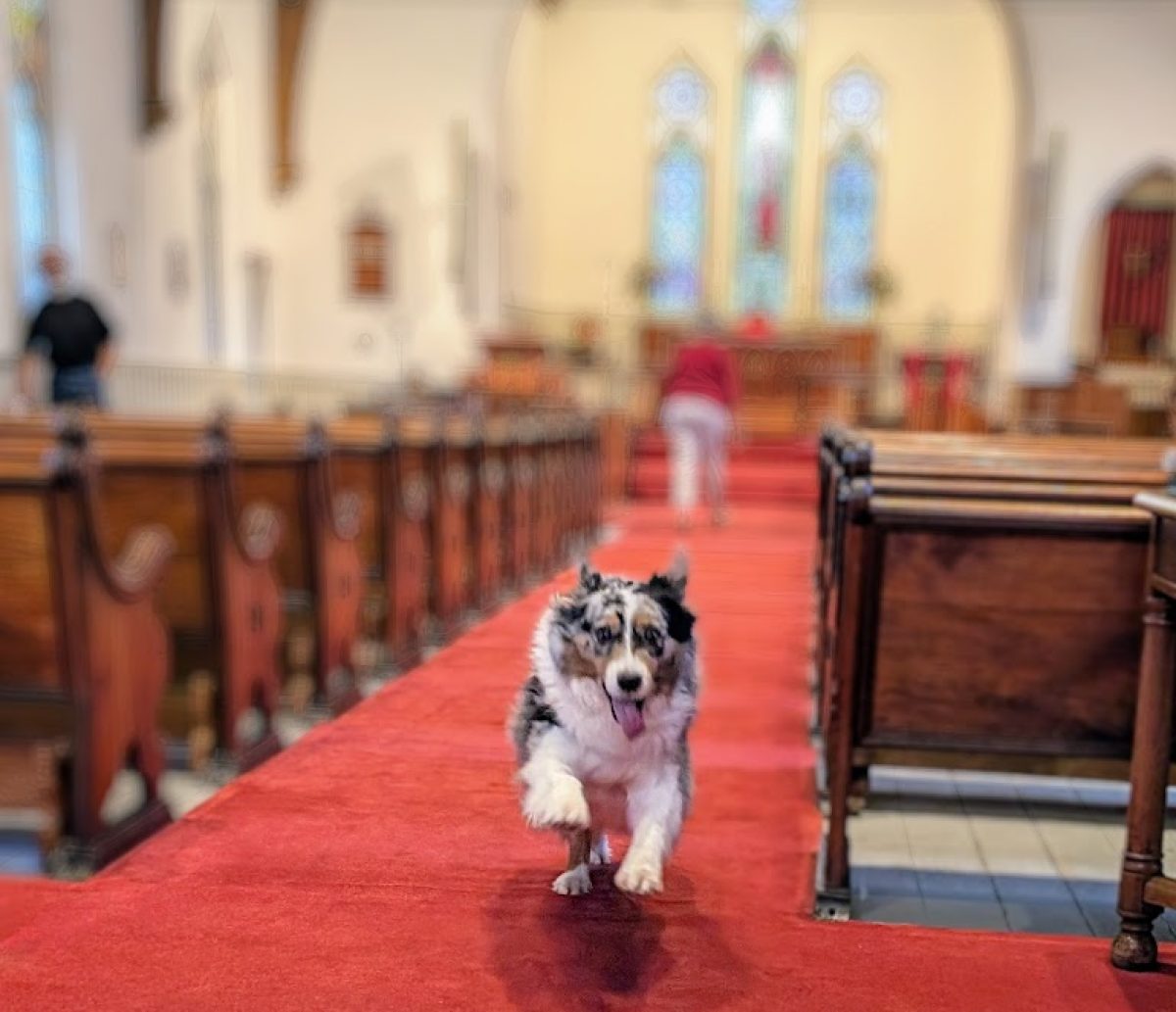
On mornings like that, my Australian shepherd dog Judah and I both agree that it is far easier to pull up the covers and stay cozy and warm in bed.

Death is easier like that because life requires something of us. Life requires that we actually throw back the covers, get up, get dressed, and go out to engage with the world.

We seek the living among the dead because that’s what we’ve been taught and it feels natural; we already know how to nurse grudges and cultivate resentments and sow hatred and start wars…it’s actually quite easy.

We seek the living among the dead because it’s just easier to live conveniently and for our own comfort and among our own kind…even when we’re fomenting violence and killing the planet in the process.

We seek the living among the dead because death, in all its many forms, is so close at hand and so easy to find—in our communities, in our politics, and in our institutions.

And still, and yet, God is with us even there.

“Mary Magdalene on Easter Morning,” Sieger Koder

We can choose the familiarity of death and God will still be with us. God will never abandon us; not ever.

That’s good news, and there is even better news: The God who made us wants still more life for us, in abundance, the kind of vibrant life that we can scarcely imagine.

God has a dream; and especially in these Great Fifty Days of Easter, God dreams of a richer life for us, for all of us, for the whole of God’s creation. And God has turned this dream into a promise by raising Jesus from the dead, and God seals this promise with the testimony of women in a patriarchal society.

Yesterday morning in my little parish here in (snowy) Saugatuck, Michigan, we baptized a baby as part of our Easter Day jubilations. His name is George Alexander River Burt, and how wonderful that one of his names is “River”! Into that glorious river of new life that flows from an empty tomb, we baptized that dear baby in endless Alleluias and with a gladness that shall never die.

We also made some promises to George. We promised to do all that we can to ensure he never, ever hears anything about God that isn’t loving, graceful, and full of life. We promised to help him know that he is a cherished child of God, that he himself gives God endless delight.

I led the gathered faithful in those promises with tears in my eyes because many of us didn’t grow up that way, with all those reassurances and with such fortifying confidence in God’s love for us. That’s exactly why we renew those promises for ourselves whenever we make them for someone else. And on Easter Day in particular, we also ask God to lead all of us out of our various tombs, whatever they may be, and into the shocking brightness of a new day.

Shocking, because God will be with us regardless of the choices we make.

And this is also true: God still longs for us to choose life, abundant life.

So let’s do it.

“Art of the Redemption 3: Resurrection,” Josef Zacek

Brazen Women, Cross-Dressers, and Canine Caskets

That’s one way to summarize the recently concluded 77th General Convention of the Episcopal Church, and apparently the preferred way for no less an American institution as the Wall Street Journal.

Religion can make people a bit crazy. But what exactly is in the New York City water supply that would lead a WSJ writer to describe General Convention as a spectacle of “sheer ostentation” loaded with a “carnival atmosphere”?

Was WSJ’s Mr. Akasie writing under the influence of martinis (a fault of my own, which I freely admit) when he described the Presiding Bishop of the Episcopal Church “brazenly” carrying her staff of office? Brazenly, really? Or perhaps it was a martini or two later that led him to describe Bishop Jefferts Schori as “secretive and authoritarian” during her “reign” thus far. (Anyone who knows her – as I do – finds that ludicrous in the extreme.)

Granted, name-calling is actually quite effective – but in grade school. Presumably we leave behind such childish behavior in adulthood, and if not in our personal lives, then certainly in our professional lives and most certainly if we’re reporting news or even commenting on it in the pages of what was once a prestigious newspaper.

The WSJ was not alone in its bizarre spin on the business of the Church in Indianapolis. Bloggers are of course free-range anyway, but some online sites have come to be trusted locales for thoughtful reflection and reporting. Belief.net used to be one of those trusted sites. Alas, that train left the station some time ago.

If anyone needs any further evidence for Belief.net’s demise, the recent screed by its “senior editor” about General Convention should suffice. There we learn that the pioneering action of Convention to include gender identity and gender expression in the church’s non-discrimination canons amounts to an endorsement of “cross-dressing clergy.” (Seriously, I couldn’t make this stuff up.)

If nothing else, the Wall Street Journal and Belief.net make The Rev. Dr. Kendall Harmon look reasonable and mainstream by comparison. I wrote just recently about Fr. Harmon’s description of the Convention as “unbiblical, unchristian, unanglican, and unseemly.” (I will try to resist wondering whether Fr. Harmon paid these other writers to look foolish…)

So, yes, religion can make people temporarily insane. I get it. But here’s what I believe is the real take-away from all this absurd reporting on General Convention: religious patriarchy is shuddering in its last gasps.

I’ve written on this before (here) and it’s not going away. So here are just two more reasons why all of us who care about the gloriously peculiar faith of Christians need to focus our attention on male privilege, and then I’ll add a final Pauline note. (Oh, and don’t miss this great piece from the Bishop of Arizona about similar topics.)

1. Men Aren’t Brazen (Even When They Are)

So when’s the last time you heard the Archbishop of Canterbury described as “brazen”? I might be out of touch with language on the street, but I have never, ever heard the kind of description of a male bishop that Mr. Asakie used to describe the Most Rev. Katherine Jefferts Schori:

Bishop Jefferts Schori is known for brazenly carrying a metropolitan cross during church processions. With its double horizontal bars, the metropolitan cross is a liturgical accouterment that’s typically reserved for Old World bishops. And her reign as presiding bishop has been characterized by actions more akin to a potentate than a clergywoman watching over a flock.

Where in the world does anyone begin to parse that bizarre paragraph? I would of course love to know what it means to carry a cross “brazenly.” Did this man pass high school English? More to the point: Women are “brazen”; men never are, even when they do exactly the same things.

Still more: why the gratuitous description of our Presiding Bishop’s tenure as a “reign”? That word might well have appeared in stories about the Archbishop of Canterbury or the Pope or occasionally other male bishops, but not very often.

The Presiding Bishop leaving General Convention (thanks, Susan Russell). Note: no “brazen” staff in hand.

God forbid that women reign over anything.

2.  Men in Dresses Kill Puppies

Ludicrous? Yes. Nonsensical? Yup. But that’s what we get when we combine the Wall Street Journal with Belief.net. Mr. Asakie took great pains to include the resolutions concerning liturgical rites for companion animals in his article (apparently just the attention to non-human animals is enough to spark ridicule, and that speaks volumes).

Meanwhile, on Belief.net, Rob Kerby finds news from General Convention “stunning” and for mostly the same gendered reasons:

The headlines coming out of the Episcopal Church’s annual U.S. convention are stunning — endorsement of cross-dressing clergy, blessing same-sex marriage, the sale of their headquarters since they can’t afford to maintain it.

A friend of mine on Facebook said it all (and I paraphrase a bit): “Men who dress like mothers and insist on being called ‘Father’ are objecting to transgender inclusion?” Well, indeed. But that’s not all. Please do not miss that property management and finances are linked in a single paragraph to gender issues: women can’t deal with money. (Oh, I am so glad my mother is not reading this…)

Look, if a supposedly “senior editor” at belief.net equates transgender concerns with “cross-dressing,” we have some issues to discuss, not least would be how men treat all those who don’t “dress” like creatures worthy of care, respect, and dignity – like non-human animals.

The link between misogyny and animal abuse deserves its own blog post, and I’ll do that soon. For now, suffice it to say that the denigration of women and the facile dismissal of the rites for companion animals belong to an important constellation of issues around male privilege.

3. St. Paul Screwed Things Up – Thank God

Don’t even try to create a coherent theology from Paul’s New Testament letters. I think it’s much more fruitful to notice where Paul gets carried away, where he waxes eloquent and crazy. Where he just can’t contain himself because of the wildness of the Gospel and pushes all the known boundaries, his own included. There are many examples of this in his letters. I have Galatians 3:28 in mind right now.

I know that’s overused. It’s critiqued, parsed, sliced and diced to within an inch of its life. But let us try to listen again to Paul’s exuberance: “In Christ there is no longer Jew or Greek, there is no longer slave or free, there is no longer male and female.”

Just try putting yourself back in first century Palestine, a Roman province, and consider the implications of what Paul wrote. He upended, overturned, dismantled, and dissolved all the basic social and religious distinctions shaping his society.

Whatever that biblical passage might mean for us today (and there are so many things!), surely it’s time to rethink how much energy and time and money is spent on maintaining gender role distinctions – okay, let’s be honest: male privilege. That would actually be a rather modest reading of Paul’s letter, but let’s just start there.

Those of us in Christ would no longer describe women as “brazen” when they do the same thing as men. We would no longer describe gender difference with terms that men use to belittle women. We would no longer abuse non-human animals as if they were women. Actually, we wouldn’t abuse anything at all.

I think that might count as progress. And if Christians actually lived this peculiar faith, journalists might be less willing to look so terribly foolish.

Oh, and lives might be saved, too…