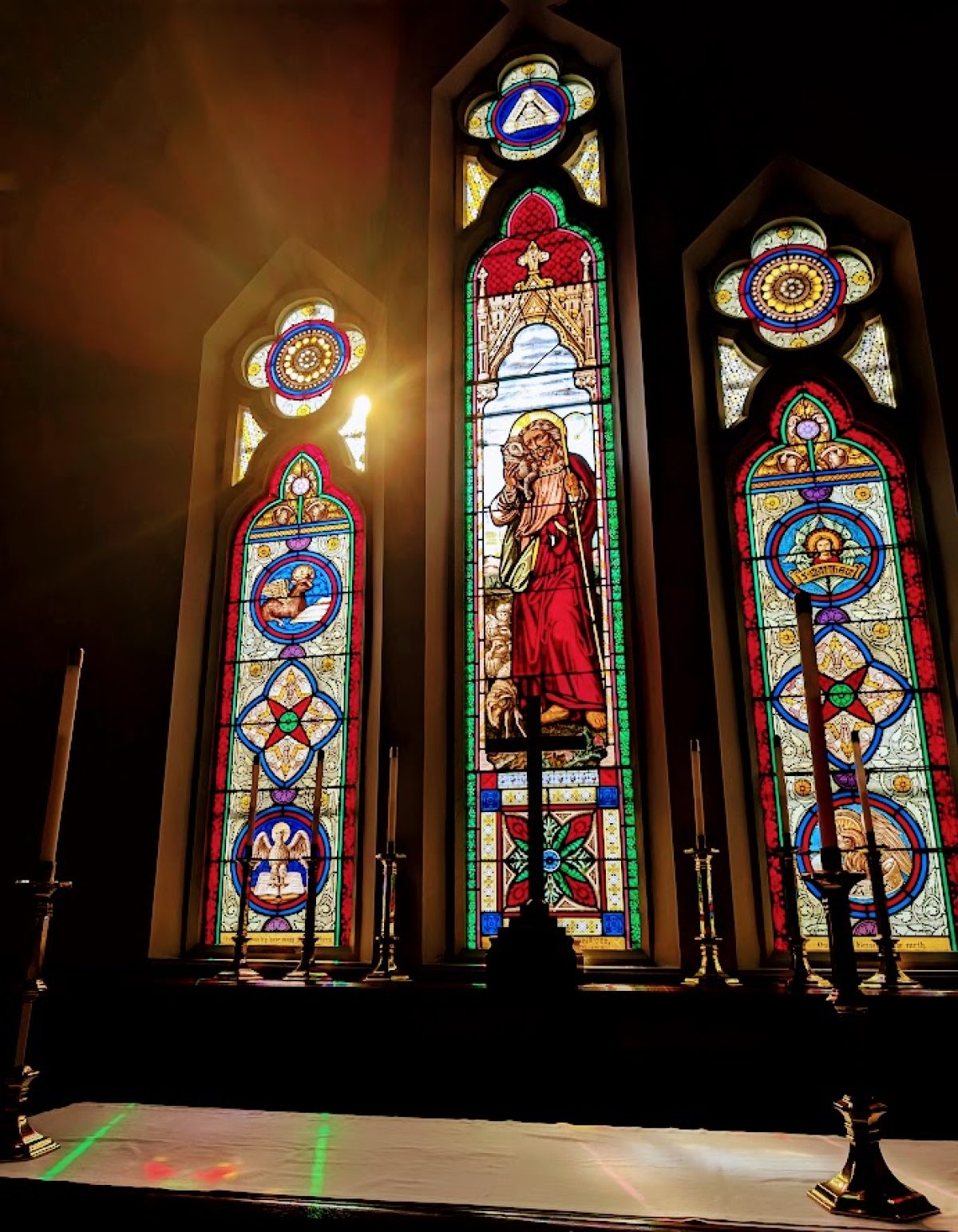
Many of us heard a portion from Matthew’s account of the Gospel yesterday morning in church, on the first Sunday of Advent. Matthew’s Jesus is talking about the so-called “end of the world,” the day and hour of which no one knows (not even him). But its arrival will be dramatic and dismaying: “Then two will be in the field,” he says; “one will be taken and one will be left. Two women will be grinding grain together; one will be taken and one will be left” (Mt. 24:40-41).
It’s fairly easy to dismiss those traces of an ancient apocalyptic scenario, but I can tell you firsthand what it feels like.
Around 1983, the year I graduated from college, people began to disappear. I started paying attention to this strange phenomenon two years later, my first year in seminary.
I knew a couple, Terry and Francis, who lived in New York. Each of them worked for the same advertising and marketing company, sharing ideas and strategies both inside and outside of the office. With hardly any warning, Francis was struggling to manage work and home life without Terry, as if Terry had suddenly been snatched away by aliens from outer space.
A seminary classmate told me about some friends of his back in San Francisco, David and Brad. They had moved there as roommates a few years earlier from the Midwest. They might as well have been a couple as they spent nearly all their spare time together exploring the city, taking trips to Napa Valley for wine tasting, or sailing on the Bay. Just as suddenly as Francis had, David found himself alone, without Brad by his side.
Before long, we knew more about the aliens who had been snatching these people away. They were given names like pneumocystis pneumonia and carposi sarcoma. A seminary professor started referring to this phenomenon like a thunderstorm—you just didn’t know where the lightning would strike next.
The storm was called HIV and AIDS, and we had no idea what the next ten years had in store for so many. Even if we did, no one could have prepared adequately for that kind of assault. Back then, young men who were perfectly healthy one day were admitted to the hospital the next, never to be discharged—just as Matthew’s Jesus described, one was taken, another left.

Sometimes more than one, far more. I heard of someone who lost more than 250 friends and acquaintances to this disease. I’m not sure I can believe that. Perhaps he was exaggerating. Or perhaps my mind’s gatekeeper refuses to let that information in, for fear of what it would do to my sanity. I did sometimes wonder how he, the one who had lost so many, had kept himself from going completely mad, running into the streets and screaming incoherently. Perhaps he eventually did, and I, for one, certainly wouldn’t blame him.
A dear friend of mine, Jim Mitulski, was the pastor of the gay-positive Metropolitan Community Church of San Francisco at exactly that time of apocalyptic dismay. For longer than I can begin to fathom, Jim was conducting at least one funeral every weekend in his congregation, sometimes more than one; that he kept anything like his sanity is a miracle of God’s grace.
I consider Jim a powerful minister of the Gospel and a prophet of divine justice, who continues that ministry today as one of the best preachers I know. It’s also extremely important that this history is remembered, and now, thanks to a wonderful podcast project called When We All Get to Heaven, this slice of history is available to many more.
This is a remarkable documentary project telling the story of that church based on an archive of 1200 cassette tapes recorded during the height of the AIDS epidemic (many of them are Jim’s sermons). I cannot recommend this podcast more highly.
The importance of memory for activism also appeared in 1988, when the United States and many other countries began observing World AIDS Day each year on December 1. This became an important moment on the calendar for remembering—all those who were sick, those who had died, the many instances of truly heroic caregiving and tender accompaniment of so many thousands. It was also an important observance for the sake of public health; we cannot combat a deadly disease without being made aware of it, knowing its causes, and taking action for prevention and treatment.

For the first time since 1988, the United States government will not be observing World AIDS Day today. This decision is a departure from a decades-long tradition observed by both Republican and Democratic administrations; many public health experts and medical professionals are denouncing this decision as “shameful and dangerous,” and even reminiscent of the early days of the HIV/AIDS epidemic when the government largely ignored this disease. Just like the policy decision earlier this year to end USAID grants for HIV prevention and treatment worldwide, the decision not to observe World AIDS Day has profound social consequences for public health—people will die.
And so Advent begins, as it always does, with a healthy dose of apocalyptic Christianity. Quite honestly, I happen to like Advent’s apocalyptic character; it faces the hard realities of the world directly and then invites, even begs us to summon hope from our traditions.
That combination of memory and hope—and the world-changing activism it can inspire—appeared vividly to me shortly after moving to Berkeley in the early 1990s. I saw a T-shirt while strolling through the Castro district in San Francisco; in simple poignancy were these words on the shirt: All I want is a cure and my friends back.
I can’t think of a better one-line summary of the character of Advent. For all its liturgical complexities and religious patina, let’s not miss that poignancy, especially on this day, when our own government is yet again trying to erase so many of us.
And let every community of faith boldly proclaim the heart of the Gospel on this very day: God Erases No One.


