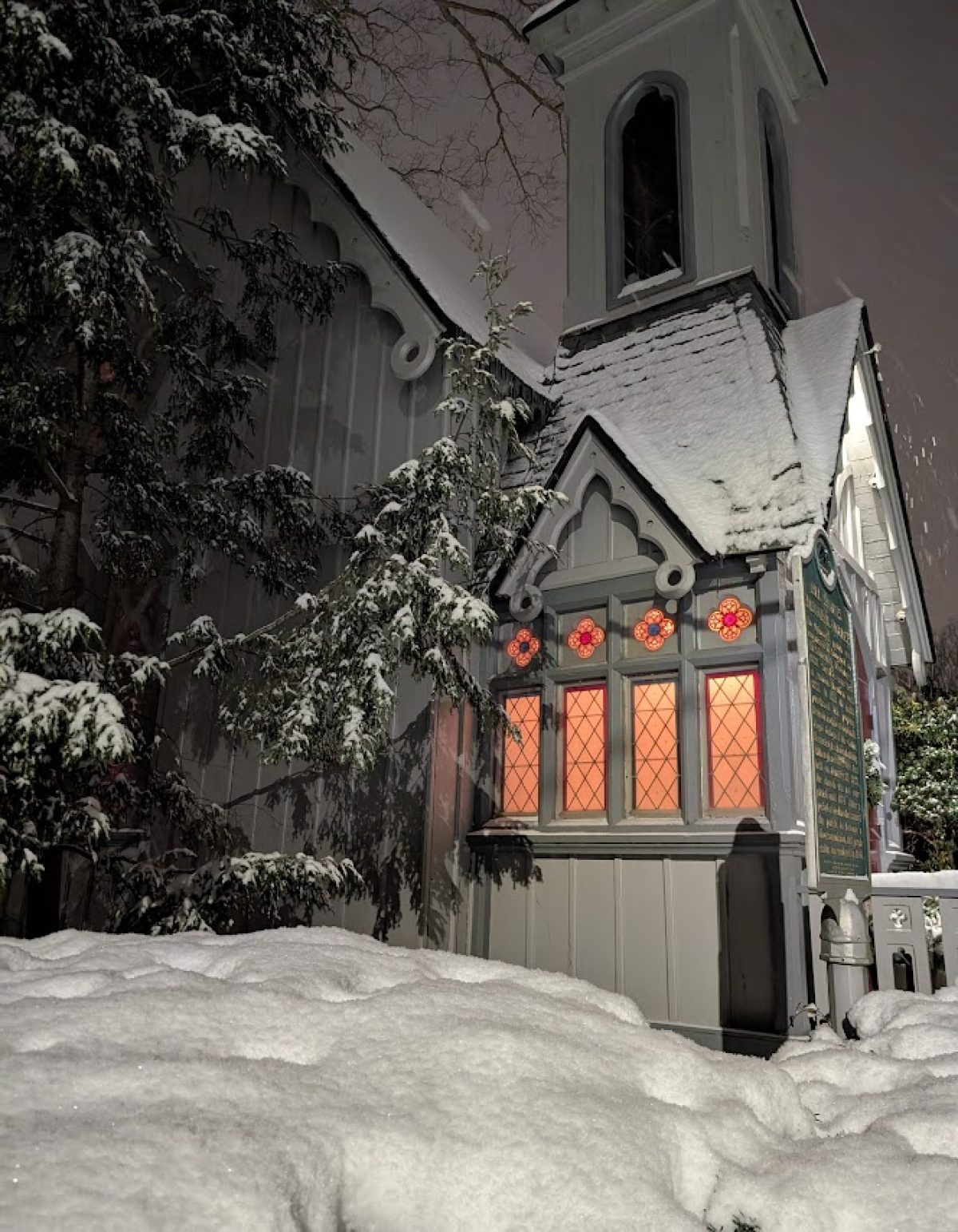
There’s a certain style in modern American visual art that always tugs on my holiday heartstrings. Examples include Currier and Ives lithographs and Norman Rockwell paintings. These easily summon fond childhood memories of Christmas, and I usually extend those memories outward into a kind of nostalgic reverie about American life more generally; as a child, I thought everyone in every country celebrated Christmas, and they did it just like we always did in the western suburbs of Chicago.

Those childhood memories conjure images of an American society that never really existed, a whole world in which everyone knew what was going on, how to behave, and looked happily toward a future of not only safety but also prosperity and comfort.
The world seems decidedly less safe today, even regularly violent. So much is unraveling, not only culturally and politically but also ecologically. I stay current with the daily news but quite often feel disoriented and have no idea what’s going on. Perhaps few, if any, ever know what’s really going on—not even scientists.
Not long ago, the James Webb Space Telescope revealed a set of surprisingly massive galaxies and black holes that would seem to demand a revision of standard theories about how the Universe emerged. That same telescope recently detected not just an unexpectedly massive black hole but one that appeared to be fleeing its own galaxy and leaving a trail of ejected stars in its wake, a trail approximately 200,000 light years long (that’s not supposed to happen).
Years ago, I used to think that being religious helps us to know what’s going on in the Universe. But not even with the most sophisticated instruments ever devised can tell us with any precision how stars dance through the galaxies. As English priest Martyn Percy has noted, the seasons of Advent and Christmas remind us that we simply cannot stretch our words far enough to explain or even grasp the mystery we call “God.”
Over time, I have come to realize that my faith as a Christian offers something much richer than knowledge. Religious traditions—all the stories and rituals and furniture and clothing and sanctuary spaces—religious traditions remind us that what we think is going on barely scratches the surface of reality. Beneath, within, entangled, and woven throughout the routines of our ordinary lives the divine light shines and beckons.
Yes, we have stories about angels delivering a message and about a heavenly chorus praising God during this mythical and magical Christmas season. But the point of these stories is not the extraordinary spectacle; the stories direct our attention instead to the working-class family with a pregnant teenager, and the migrant workers tending sheep, and the livestock gathered around a feeding trough.
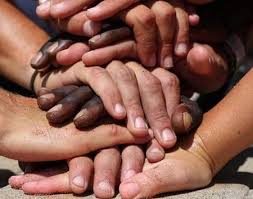
These ordinary people with ordinary lives mark where the very presence of Creator God appears; and we must not treat those moments lightly. That’s exactly why we dress up, and sing carols, and adopt funny bodily postures in highly stylized buildings—and it’s also why Christians gather around a Table where everyone is welcome to receive physical tokens of God’s own life in the form of bread and wine—and in the wonderful parish where I am privileged to serve as a parish priest, when we say “everyone,” we mean it, no kidding. As I like to say, at All Saints’ Parish, “all” really does mean all.
Especially in the Christmas season—and in a world of festering suspicions and wary glances and divided communities—especially during Christmas, a season devoted to God’s own commitment to dwell among us in the most vulnerable flesh imaginable, this is the time to ensure that everyone, every single person, is made to feel welcome at God’s own Table.
That’s why religious faith communities must notice and name the wider cultural realities in which we live. Compelling and lifegiving forms of religion don’t just float above the fray of human communities; all the stuff of human interaction and conflict, of human joys and sorrows, of our entanglements with other animals and ecosystems—all of it is the material from which we spin the fabric of faith itself and where God is pleased to be woven into the threads of our bodily lives and relationships.

All of this is on display in the familiar story of the Nativity we hear each Christmas Eve from the Gospel according to Luke (2:1-20). The details in that story matter. Luke makes sure to tell us that the moment of nativity happened when Ceasar Augustus was the Emperor of the Roman Empire; and when Quirinius was the governor of Syria. We should note that Judea, where Bethlehem is located, was part of a larger imperial province called Syria-Palestina, and where a Roman governor supervised puppet kings like Herod. And these details can, at the very least, serve as a good reminder that our political lives as humans have always been complicated, fraught, and quite regularly terrifying—exactly where God shows up.
Just as we cannot possibly fathom what’s really going on in the “vast expanse of interstellar space,” our own lives and the lives of our neighbors are often just as perplexing. All of us live with concerns and convictions, we all harbor dreams and moments of dread, high hopes and crushing sadness about all sorts of things.
We sort through all those complexities as best we can, and we will not always agree with each other about how to sort them out, even about those things that are most vital and pressing—probably especially those. We don’t have to agree, but we must wrestle with such things together, trusting that the presence of God is with us in the struggle—out there in hilltop fields watching our sheep, or tending the livestock in a cave-like stable, or busily caring for guests in a sold-out inn, and all the while staying vigilant, not knowing when the weight of imperial Rome might come crashing down on our heads.
We don’t have to know exactly what’s going on, and we don’t have to understand perfectly how everything works before we decide to care for the needy and lonely, and to love each other fiercely and tenderly. To love each other just as God loves us, in the most ordinary stuff we can imagine in this mysteriously physical universe: the flesh of a newborn baby.
As American storyteller and former priest Brennan Manning once noted, “You could more easily catch a hurricane in a shrimp net than you can understand the wild, relentless, passionate, uncompromising, pursuing Love of God made present in a manger.”
Christmas is not the time for explanations, no matter how clever our philosophies or theological systems; we do not gather in worship and prayer at Christmas for greater understanding or more precision in our knowledge; the grand mysteries of time and space need no parsing at the manger; and the wonderful befuddlements of human life and relationships can simply remain gloriously tangled into knots.
Let all of that be just as it is, just for now, just for a moment. These Twelve Days of Christmas invite us to hear once again the message of angels delivered to shepherds in a field, and to see an anxious and exhausted couple caring for a newborn baby—and then to marvel, with full-throated praise, or with a single tear on our cheeks, at the presence of God dwelling gently among us.