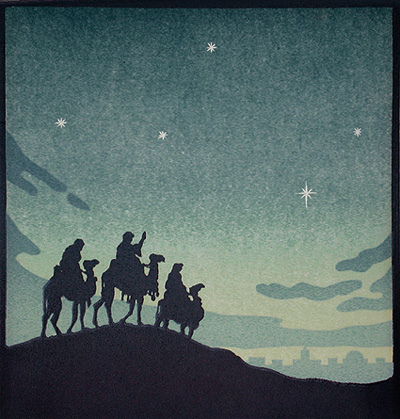
Strangers from the East presented extravagant gifts to the child Jesus (Matthew 2:1-12). This became known as “The Epiphany,” but I’m realizing these days that those strangers, the “Magi,” are the gifts to us—and not a moment too soon in a xenophobic world of rampant white supremacy.

Reading the Magi as themselves gifts is thanks of course to the Gospel writer known as Matthew, who is the only one of the four canonical gospelers to include the story. It’s worth pondering why that story mattered so much to Matthew, or more significantly, to Matthew’s community, and now also to us—on this very day when many Christians celebrate the Epiphany, just as my parish did yesterday in worship.
We might recall, first, that each of the four accounts of the Gospel emerged from its own particular community of faith, each with its own demographic profile, colorful characters, and distinctive perspectives on God and Jesus. These communities had access to a variety of stories and traditions about Jesus, and eventually someone in each of these communities—or perhaps a small group—decided to write it all down and create a “gospel.” These writers adapted and revised those stories to meet the needs of their respective communities, and this helps to explain the variations among the four canonical accounts.
Scholars generally agree, for example, that Matthew’s community consisted mostly of Jewish followers of Jesus. A classic indication of this is the “Sermon on the Mount”—just as Moses brought the covenant to the people on Mount Sinai, so Matthew’s Jesus preaches about the “new covenant” on a mountain. Luke’s Jesus does this instead on a level place, a “plain.”
By noticing how these gospel writers connected traditions about Jesus to the particular issues facing their own communities, we can do the same work today—and not just theologians, pastors, or preachers, but the whole community. The Church is a “community of interpretation” where all of the members prayerfully discern how to read our sacred texts for the shared ministry to which God is calling us today.
How, then, might we read the iconic story from Matthew about the so-called “wise men” from the East, the ones who followed a star to Bethlehem and presented gifts to the child Jesus?
The divine presence in Jesus is shown to these gift-bearing strangers who were probably something like astrologers or perhaps those who practiced what we might call today an “earth-based religion.” The Greek word for these “wise men” in Matthew is magoi and it’s related to a Persian word for “powerful” (it’s also at the root of our word “magic” and “magician”). Some have suggested that this might have been a title given to Zoroastrian priests, an ancient monotheistic religious tradition that emerged from present-day Iran and Iraq. That tradition was devoted to connecting cosmic powers to earthly affairs—thus the appearance of an unusual star in the sky would have caught their attention.
Matthew’s story is often interpreted as a depiction of the global significance of Jesus—the meaning of his humble birth extends beyond Judea, and will have influence beyond the people of Israel, and reaches beyond standard borders to the East, to outsiders and foreigners. That sounds rather benign, but recalling that this is Matthew’s story, and that Matthew was likely embedded in a Jewish-Christian community, this story of the Epiphany would have been startling and should be read as both encouraging and scandalous at the very same time.
To live as inheritors of ancient Israel’s traditions and as followers of Jesus, as Matthew’s community apparently attempted, was often a complex religious undertaking. It was not always clear to which kind of religious or social category one belonged, or where one should belong. In many ways, those first-century Jewish Christians were boundary crossers—just like the Magi.
Those foreign astrologers traveled a long way, probably crossing a number of geopolitical borders. They were not Judeans, not even Israelites, so they were crossing a religious boundary as well. And these religious outsiders are among the very first to encounter Jesus—and by doing so because of the appearance of an unusual star, perhaps Matthew is suggesting that God deliberately called foreigners as witnesses to this profound moment.
Outsiders with privileged access to God’s own self-revelation: that’s a scandal that turns out to be a comfort.
Imagine Matthew’s community of Jewish Christians hearing this story: If God can lead peculiar border-crossers to God’s own presence in the flesh, then perhaps our own shifting and jumbled religious borders can be a source of insight for us as well.
Matthew’s approach to the quandaries faced by his own community seems to me quite compelling for every human community. The story about the Magi encourages us to look for epiphanies in unlikely places and among unexpected people, maybe even other species. But Matthew takes that encouraging scandal even further.
The gifts these Magi present to Jesus are not just random but function as symbols for the way Matthew wants to tell the rest of the story: myrrh was an embalming oil, prefiguring the death of Jesus; frankincense—an aromatic incense derived from medicinal plants—evoking the priestly prayers Jesus offers for our healing and thriving; and gold, representing the sovereignty of the risen Jesus, who appears on a mountain once again at the end of Matthew’s account of the Gospel, where he claims “all authority in heaven and on earth.” That mountaintop moment uniting the skies above and the ground beneath is precisely the moment those Zoroastrian Magi had dared to hope for.

Set aside those particular symbols for a moment and notice Matthew’s story-telling strategy for his community of Jesus-following Judeans: foreigners can help us navigate our own and often disorienting history.
Right there, in that strategy, is where Matthew’s Magi become gifts to us. This is the insight they embody: we need strangers and outsiders to help us interpret our own story.
Matthew’s strategy is not easy to embrace, of course, and it challenges the all-too common human tendency to gather only with those who are just like us. This is actually a cautionary tale from Matthew, warning us about borders: the walls we build for “self-protection” can instead prevent the insights of strangers from reaching us for our thriving.
The journey of the Magi offers a wonderful image for embarking on a journey into 2025, and for at least two reasons. First, the Magi were brave, setting out with only the light of a star to guide them to an unknown destination. We cannot know what’s ahead in the coming weeks and months, but the Magi themselves would encourage us with the courage of companions, and to make the journey together, trusting in divine guidance.
The second reason fortifies the first: the journey of the Magi led them to a place, Matthew says, of overwhelming joy. Whatever the coming year might hold for us, it will certainly require from us some hard work, careful discernment, and courage. Yes, and the journey itself will lead us toward joy.
Perhaps now more than ever, we need the divine gift of peculiar strangers to inspire trust on a journey toward joy. I know how trite that sounds, and this even more so: Matthew’s story can guide us along this path, like a bright star in the night sky—trite perhaps, but also vital for what it means to be “church” in an age of anxiety. Our shared faith and our brave companionship is the starry light we need.