Like many other white people, I first heard the term “woke” roughly ten years ago after the protests in Ferguson, Missouri, over the killing of Michael Brown. The term quickly became associated with Black Lives Matter activism, and also with wider social concerns that included both gender and sexuality.
“Woke,” however, has much earlier origins. After the horrors of institutional slavery, the devastation of the American Civil War, and the rocky period known as “Reconstruction,” the early twentieth century held a great deal of promise and potential for racial healing, and a new chapter of economic prosperity for all racial groups.
But there were also notes of caution, coming mostly from Black musicians and visual artists in the 1920s and 1930s: “stay woke,” they said; pay attention and be vigilant; don’t take anything for granted.
Turns out, those were important cautions; the era of Jim Crow segregation and lynch mobs soon followed.
The Gospel writer known as “Mark” composed his account of the Gospel not long after a turbulent and violent period in first-century Judea. “The Jewish War,” as it is sometimes called, occurred right around the year 70 when Judeans rose up against their Roman occupiers; Rome destroyed much of Jerusalem during that war, including the Temple. This came right after decades of severe economic hardship among those we would call the “working poor” during the reign of King Herod.
Many of us heard that time of upheaval referenced in church yesterday, on the first Sunday of Advent. The opening verse of the Gospel passage—“after that suffering”—probably refers to those unsettling events (Mark 13:24-37). Mark’s Jesus, in other words, is trying to prepare his listeners for a time of significant social unrest and political violence. “Keep awake,” he says; pay attention and be vigilant; don’t take anything for granted.

“Stay woke” and “keep awake” come from two very different cultural and historical eras, yet the message of vigilance seems remarkably similar. The key question they pose is this: to what should we be paying such close attention? World events? Our own anxieties? Portents of doom in sea and sky?
The Gospel passage assigned for the first day of the new liturgical year (one of my favorites on the calendar) comes from a chapter sometimes referred to as the “mini-apocalypse” in Mark’s account of the Gospel. It’s striking that this chapter is the longest speech of Mark’s Jesus (in Mark, Jesus is mostly an action figure and doesn’t actually say very much), and it’s also striking that this longest speech is steeped in apocalyptic images.
Christians have interpreted this passage in many different ways over the centuries—from the fall of Rome, when it was sacked by barbarians in the fifth century, to the nineteenth-century reframing of the Second Coming of Christ as that sense of inner peace that passes all understanding.
Regardless of the interpretive framing of such texts, Advent will always provoke, stymie, and vex. How could it not when Mark’s Jesus warns us that the sun and moon will refuse to give their light, and all the stars will fall from the sky?
I know there are some Christians who truly do expect that kind of fundamental realignment in our solar system and an unraveling of our galaxy. I don’t—and I don’t think even Mark thought such events were likely, not in his lifetime and probably not ever.
If astronomical chaos is unlikely to happen any time soon, perhaps Mark is inviting us to wonder what is likely to happen in a world that seems to be careening toward catastrophe on nearly every front.
Ethnic cleansings, hospital bombings, ecological collapse, mass extinctions—how do we read those signs of these times today? If we stay awake and pay attention, will we find God’s presence in such moments of distress? What kind of hope—I mean, real and tangible hope—does the Church offer to a world in pain?
The whole season of Advent poses that question of hope with urgency, and we cannot squirm our way out of it, and we dare not try, either.
This urgency of hope shaped the insights of Hannah Arendt, one of the most influential political philosophers of the twentieth century. She studied carefully the rise of totalitarian regimes, including in Nazi Germany and Stalinist Russia. One of her main takeaway points is rather startling. A momentous difference between the modern Western world compared to all the centuries that came before, she argued, and which makes authoritarianism possible, is the loss of any expected Final Judgment.
That’s not just a startling but also rather peculiar thing to note about the modern world, except that it sounds as if she could have written that cautionary tale today. Losing any sense of divine judgment has meant, she noted, that the worst people among us no longer fear accountability, of any kind, and the most oppressed among us have lost nearly all their hope.
To fill that intolerable gap, the modern world tries to fabricate the paradise we long for, but ends up creating the hell we dread (German concentration camps in the 1940s, she observed, resemble nothing so much as Medieval visions of Hell).
That’s one hell of a quandary, and I’m grateful for the multiple ways we might engage with the question of hope posed by Advent.
Theologian Daniel Day Williams, for example, suggests that the classic and fantastical images of Advent—the Second Coming of Christ, the Final Judgement, and the End of Time—that these are symbols residing on the boundary of knowledge; they perch there, like sentinels, marking that line beyond which, they declare, our reason and experience will fail us.
That doesn’t make all those notions irrelevant or disposable. To the contrary, these symbols on the very edge of what we can know invite our trust. Life takes us up to the very edge of the map, where the road abruptly ends, beyond which we must choose whether we can trust that God is with us, that God will accompany us, and that God will provide what we need.
When the world is falling apart—either on a global stage or in our own living rooms—we yearn for something more than scolding from our sacred texts (we should have known better!); and we need something far more than mere moralizing from our religious traditions (shape up or things will get worse!). We must instead dare to find the very presence of God in the midst of our terror, and then help others do the same.
Let the fig tree be your parable for this, Jesus says (Mark 13:28). When the tree starts to put forth its leaves, you can trust that summer and its fruits are coming. Pay attention like that, Jesus says, for the sake of trust.
The symbols on the edge of our knowing—and the fig tree itself is one of them—these symbols can stretch our imagination toward the God who is always coming to meet us, always already appearing among us, always bidding us still onward toward that horizon over which we cannot presently see—and thus we must travel with trust.
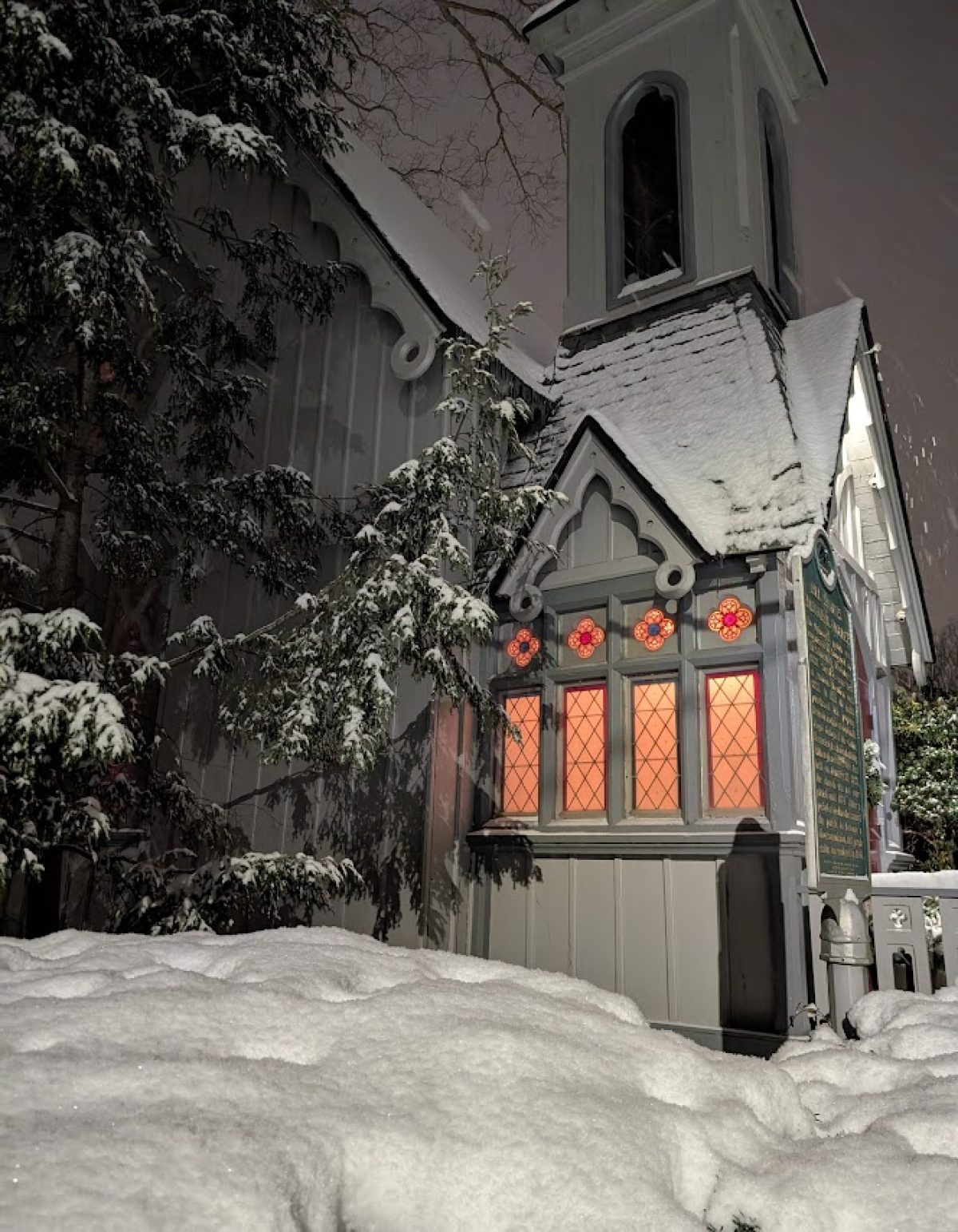
This is why, by the way, my little parish along the “arts coast” of west Michigan devotes so much time to visual art. There is always a featured image on our liturgy leaflets, and in our weekly ad we place in the local newspaper, and we place nan image prominently in our weekly email newsletter (you, too, could subscribe to that!).
Art of all kinds can help us expand our imaginations, liberate us when we get stuck, and enhance our willingness to reach beyond the edge of what we can know with something like courageous trust.
In a world brimming with pain, God is not calling any of us to perfect knowledge or flawless solutions—these are far beyond us. But we must not therefore remain idle or merely sleepwalk our way through a disaster.
God is calling God’s people to live as a community of storytellers, and divine artists, and hospitable hosts, and players of musical instruments, and bakers of heavenly pastries, and tenders of gardens, caregivers to other animals, and funders of budgets, and still much more as all of us together offer healing to a wounded world with images of peace, as champions of justice, and lovers of beauty.
There’s really no time to waste; and we have got to stay woke and keep awake.

