post

Go On Ahead — I’ll Catch Up

God knew what she was doing when she shoved wolves and humans together and said, “I think something cool is going to happen here. Make something of this, you two.”

And make something we did. Many biologists and anthropologists alike believe that homo sapiens and canis lupus familiaris would be unrecognizable today apart from our interspecies bond. We have been nearly constant companions on this earthly pilgrimage for at least 15,000 years. We learned to read each other (dogs often did better at this than we did) and we discovered that collaboration ensures our thriving (a lesson humans might want to consider a bit more carefully these days).

Sad to say, human beings have been far less kind to what became known as the “dog” than the other way around. I have returned often to this image in one of the dozens of dog books I’ve read over the years: every loving pat, every kind word, every home made for a dog slowly but surely heals a history of human cruelty. (Next on that list in my view is the outright ban on puppy mills.)

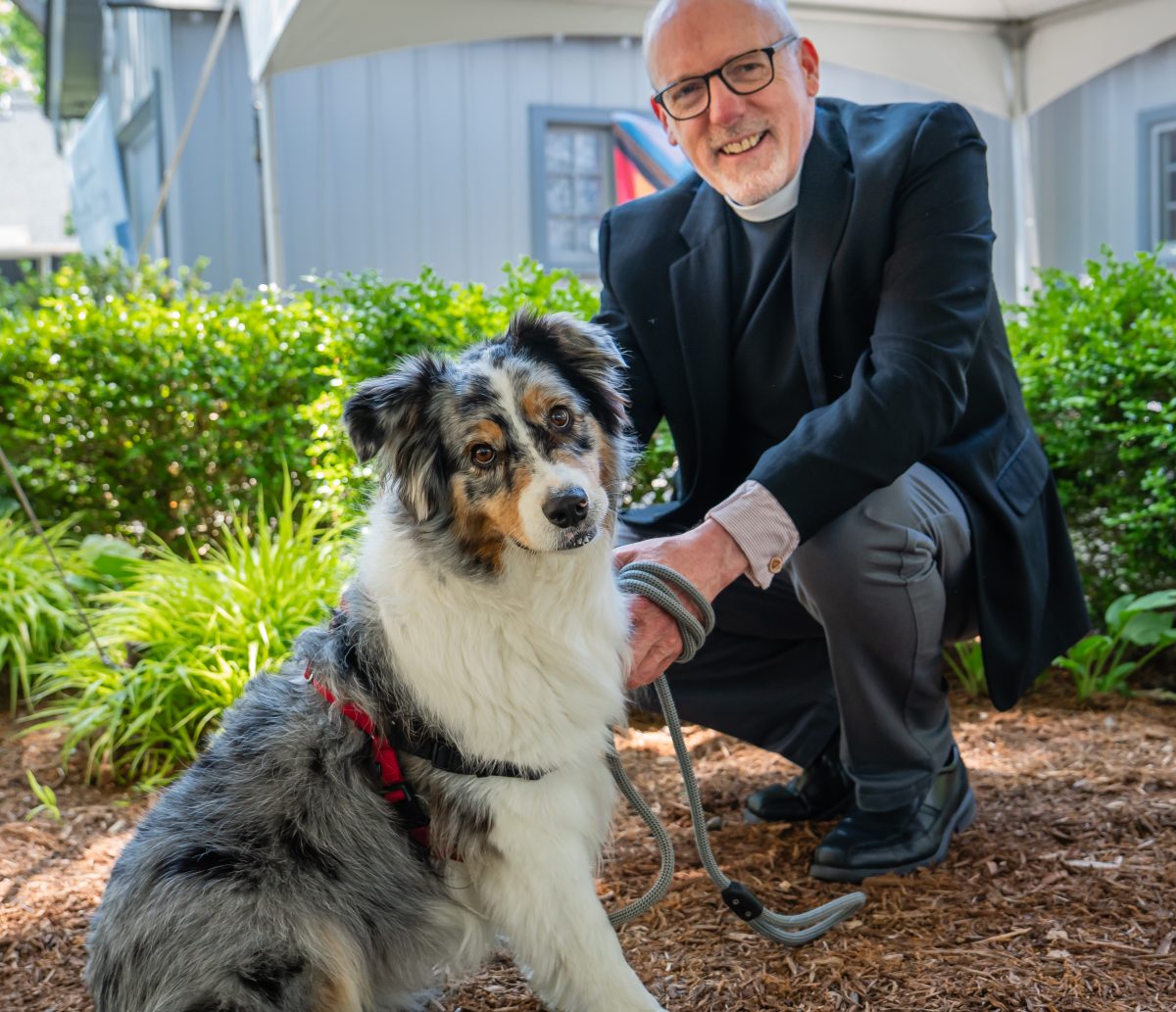
tyler_tulipsYesterday I had to say goodbye to a beloved canine companion, an Australian Shepherd dog named Tyler. (For anyone facing a similar situation, I highly recommend reading this blog post on how to make the most difficult and loving decision we are called to make for the animals who grace our lives.)

I rescued Tyler from the Berkeley East Bay Humane Society when he was nine years old. He had already been at that shelter for six months because no one wanted to adopt an “older dog.” He was a bit overweight, not terribly well groomed, and a bit listless; but oh, ever so sweet. I can give this old guy two or three years of a happy home, I thought.

Turns out that regular exercise, grooming, and love stretched that estimate to six-and-a-half years. He lost weight, got his energy back, and became an integral part of my life in every respect. He died just shy of his sixteenth birthday.

I learned a lot from Tyler. A short list begins with this: be sure to take time to roll vigorously in the grass at least once a day; never say no to an invitation to play; enjoy a nap in the afternoon sunshine as often as you can; and always greet your friends as if they had just returned from an expedition to the Artic.

It’s not quite true to say that I “rescued” Tyler. It really was a mutual rescue operation. When I adopted him I was basically glued to electronic devices for nearly every waking hour. Adding a dog to the house meant making time for hikes and affection. I had already been living in the San Francisco Bay Area for fifteen years before Tyler came along and, to my chagrin, I knew nothing about parks. When I brought Tyler home I googled “off-leash for dogs” and discovered this amazing thing called the East Bay Regional Park District. A wonderful park was less than two miles from my house! Tyler and I spent countless hours running, playing, hiking, and exploring in those parks. I think it may well have saved my life; it certainly renewed my soul.tyler_oyster_beach

The peculiar faith of Christians includes affirming the resurrection of the human body after death. I cannot say in all honesty that my faith in that claim is always constant and unwavering. It’s difficult and complicated. But when I do believe it, I cannot imagine that God would care only about human flesh. After all, God created all of it, including the flesh of the beloved canine who was showered with my tears and kisses as he journeyed on.

Today I believe in the resurrection of the body – all bodies. And I choose to believe today that Tyler has gone ahead of me on a journey all of us will take. I dare to believe he might be waiting for me – even as he frolics and plays and takes a good roll in heavenly grass. I know – it’s peculiar. But today, I believe it.

So here I offer some words in honor of Tyler. I am of course heartbroken but hopeful – he’s gone on ahead and he’ll have lots to show me when I get there.

Go On Ahead – I’ll Catch Up

I imagine that you’ll limp a bit and stumble at first.
You have some healing to do with those hips and joints.
But it won’t take long. Trust me.
I know you love to run and that’s what you should do.
It will soon feel like home, oddly but perfectly.

So go on ahead. I’ll catch up soon.
Don’t look back but for a moment, and listen!
Over the strange haze that enfolds you just now
you’ll hear a familiar whistle in a voice
you’ve never heard before but have always known.

The laughter of creek-water over stones,
the scampering of field mice on their mounds,
the cry of a hawk in a pale blue sky and
the whisper of a soft breeze in the pines.
The Voice calls to you, just for you –
run and play.

And I? I shall wait, and work, and laugh, and cry
until you show me that new brook,
the unknown path through a wild forest,
running in your circles with glee and pausing
to bump my knee with your wet nose to goad me,
urging me on to run with you down the road –
the very road God has made just for us.

That will be The Day.

So go on ahead now.
Don’t worry and don’t look back.
I’ll catch up.

post

Sleepwalking through a Cataclysm: A Pentecostal Wake-up Call

“I will pour out my Spirit on all flesh,” God declares, “and your sons and daughters shall prophesy.” Many Christians heard that biblical text yesterday in church, for the Feast of Pentecost.

Prophecy only occasionally has anything to do with predicting far-off future events. Biblical prophets more often see the present with vivid clarity and then say uncomfortable things about it. That clarity of vision sometimes happens in a dream but mostly we have to be awake, with our eyes wide open.

As I thought about prophesy on Pentecost, here’s a short list of what came to mind: intractable social problems; dysfunctional political parties; erosion of the common good; a whole generation or more without any grounding in a religious tradition; and polar bears swimming for their lives without any ice in sight while poachers profit from slaughtering elephants. The list would be longer if I were more awake.

I believe most citizens of the North Atlantic (myself included) are sleepwalking through a cataclysm. I’m not sure what will wake us; perhaps only divine intervention can interrupt our somnambulist delusions.

Sound alarmist? A current catalogue of crises would begin with these:

  • About ten days ago this planet registered over 400 parts per million of carbon dioxide in the atmosphere, a level not seen for roughly three million years, even while we frack for more gas and scrape the bottom of oil-sands barrels; the irreversible tipping point for global climate change swiftly approaches and we may have just passed it (here’s a startling graph of the problem).smokestacks2
  • We now live with the most severe gap between those who control not only national but global wealth and resources and those who have virtually nothing; even conservative economists consider that gap unsustainable and it maps closely to the widening gap in education.
  • Yet another gap widens with alarming speed, the one between ideology and facts; just witness what happened to Bill Nye (the “science guy”) when he noted for a Texas audience that the moon actually reflects the sun’s light (he was booed) or what a Christian pastor said about Christianity as the founding religion of the United States that now stands at risk from homosexual activists (this matters because that pastor is now the Republican candidate for Lt. Governor of Virginia).
  • All the boring stuff about infrastructure will soon seem far less boring when this nation’s duct-taped electricity grid crashes, or when the more than 4,000 dams at risk of failure actually fail, or when the next 70-year old gas pipeline explodes; the American Society of Civil Engineers recently gave the U.S. infrastructure a grade of D+.
  • The wildly disproportionate number of African American men incarcerated in the U.S. strongly suggests that Jim-Crow culture never really ended but merely changed tactics, which includes keeping the poor in poverty and restricting their access to education.

I imagine most people think about that catalogue of socio-political problems as discrete items on a check-list. Most of us likely recognize some of their intersections and overlaps. Relatively few, however, would include all of those and more in a description of a single event, as the word “cataclysm” suggests. But that’s precisely what I now believe we must do.

I believe we are witnessing in slow-motion a singular, cataclysmic unraveling of community, of the social bonds that have for millennia enabled humans to survive and thrive. Those bonds now include the indispensable relationships with varied ecosystems, both  local and global. To be sure, many of us enjoy resilient, thriving communal bonds, even if only in our households or neighborhoods. But this is not enough, not by far, not in an era of global commerce and planetary-interdependence.

Most of us are happily sleepwalking through this cataclysm, though mostly through no fault of our own. The very conditions that set the stage for this unfolding disaster have ingeniously hidden their mechanisms from view behind a screen of comfort. As I write this, I sit in a beautiful backyard garden surrounded by budding fruit trees next to a house with an affordable mortgage. Very little about where I sit would encourage me to wake up.

bible_us_flagMany would of course lay the blame for our sleepy state at the feet of religion, especially Christianity. And they wouldn’t be wrong. Marcella Althaus-Reid (one of the more traditionalist and therefore queer theologians I know) argued that Western Christians have been lulled into a compliant sleep by adopting Western cultural sensibilities as benchmarks for Gospel values. That wedding of modern Western culture and institutional Christianity may well qualify as one of the biggest blunders in Christian history, perhaps second only to the quasi-official adoption of Christianity as the religion of the Roman Empire in the fourth century.

To the many solutions Althaus-Reid proposed to this quandary, I would add this: divine intervention. I do not mean the kind Cecil B. DeMille imagined in his silver-screen Bible epics. Divine intervention will look today like it always has, vividly illustrated by Pentecost but without the special effects. Luke’s biblical account of the earliest Christians in his Acts of the Apostles relies on very few divine pyrotechnics. He portrays instead completely ordinary people doing wildly extraordinary things, all of them inspired and cajoled by the Spirit. Luke describes that Pentecostal effect: Christians turned the world upside down (17:6).

In the midst of an unfolding cataclysm, we need some world-changing prophecy. I’m actually very hopeful that the Spirit will do today what she has done so many times before – wake us up to see the world with prophetic clarity.

When that happens, we will need another gift from that same Spirit: the ability and willingness to understand one other beyond the many linguistic and cultural barriers that divide us. And still another gift: the love that makes friends from enemies and family from friends. And yet one more, perhaps above all the others: courage.

"Holy Spirit Coming," He Qi, 2009

“Holy Spirit Coming,” He Qi, 2009

post

Counting the Deaths that Count in Eastertide

I know how many people were killed at Sandy Hook Elementary School (26, not including the perpetrator and his mother) and how many died at the Boston Marathon bombing (3). I know this (without needing to “do a Google”) in part because these horrific events took place rather recently.

I know these numbers for other reasons, too. Both of those tragic moments happened in places where I can imagine myself visiting or strolling; I can easily see my godson’s younger brother as a student at Sandy Hook. And all but a few of those thirty-one people who died were white.

I have never visited a Sikh temple nor have I ever traveled to Pakistan. There are parts of the San Francisco Bay Area (where I live) that I might drive through but likely never “visit.” Yet in all of those places adultssikh_temple_shooting and children alike have died, violently and recently. I have no idea how many unless I look it up and then search carefully through all the online search results:

Six died at a Wisconsin Sikh temple last August. Since the Sandy Hook shooting last December, 35 have been killed by gun violence in Oakland (10 miles from my house), four of them teenagers. In my own city of Richmond, 7 have been killed, one of them a teenager. (Slate offers a sobering but helpful interactive map of gun violence in the U.S., though the statistics are strangely hard to confirm.) Only God knodrone_strikews, literally, how many have died in U.S. drone strikes overseas. In Pakistan alone since 2004 drones have killed 2,358 people, 175 of them children. (Those numbers are disputed by various reporting agencies, but this animated graphic proves helpful and chilling.)

The vast majority of all those victims were not white.

Now, to be sure, these situations (let alone my  memory and attention span) are complex, multi-layered, inflected by news cycles, the “spectacle factor,” and so much more. The troubling fact still remains that I remember or know anything at all about white deaths on the other side of the country and so little about the deaths of people of color in my own backyard. Without resorting to Google yet again, I could not remember how many died just a year ago at Oikos University, a school affiliated with a Korean Presbyterian Church in Oakland (7).

I suspect something deep in the human psyche draws our attention rather naturally to the fate of those who seem most like us. If so, then white people (like me) need urgently to stretch beyond that natural tendency in a country where the vast majority of policy makers are white (and male); in a country where national news media train their spotlight on a small-town elementary school but not on inner-city streets; in a country where significant gun control legislation finally appears on the docket only after mostly white children are killed but not after mostly Asian students are shot by an Asian gunman. (The New York Times Magazine recently published a retrospective piece on the University of Oikos shooting titled, appropriately enough, “The Other School Shooting.”)

We count deaths, but some deaths clearly count more than others. I started pondering that disparity as I sat transfixed (like so many others) by the news coverage of the Boston Marathon bombing. Somewhere in the back of my brain I wondered why the whole country seemed fixated there but so rarely on Oakland, Richmond, Atlanta, New York City, or Chicago.

The specter of terrorism is clearly part of the answer. One of the Boston victims (who lost a portion of her leg in the bombing) said that it reminded her immediately of the September 2001 attacks. She was not alone, and that may be part of the problem. A commentator in London recently noted that Americans tend to panic over the prospect of international terrorism (shutting down an entire city) but seem to accept daily gun violence as routine. Those living with such violence, however, consider it anything but “routine” and more like terrorism. (Over the last two years such violence has gone up by 52% in the Bay Area where residents feel “besieged.”)

Since Sandy Hook last December through March 22 of this year, 2, 244 people have been killed by gun violence in the U.S. The demographics lurking behind those statistics are just as significant. White Americans are five times more likely than African Americans to commit suicide with a gun. African Americans are far more likely than white people to be killed by someone else with a gun. Suicide rates are the highest in states with the highest rate of gun ownership and tend to concentrate in rural areas. Homicides involving guns happen far more frequently in our cities. Digest those demographics for a moment and notice the polling data: Nearly 75% of African Americans support tighter gun control legislation while not quite half of white Americans do. (The difference between how we perceive suicide and respond to homicide matters here, too.)

Admittedly, I find statistics numbing and difficult to decipher. More visceral and gripping are the images of those Sandy Hook children and the carnage at a marathon finish line. Mia McKenzie by contrast finds those images numbing in what she names an “erosion of empathy.” Counting only the deaths that appear to count (judged by news media and Congressional action) has slowly worn done her capacity to care. Here’s how she describes it from a blog post I urge all of my white friends to read:

Some of it has to do with the fact that the wars and subsequent occupations of Iraq and Afghanistan have gone on for more than a dozen years. For many of the younger folks I know, that’s the better part of their entire lives. It’s a whole third of mine. For a dozen years we have watched as the mainstream media has ignored the deaths of so many brown children, day after year after decade. I mean, they were ignoring the deaths of Black children all over the world, including here, way before that, but we didn’t have to see them ignoring it so blatantly every morning and afternoon and evening and night on TV (that 24-hour news cycle is a bitch; they have time for everything except our stories).

Surely the peculiar faith of Christians has something to say here – peculiar, that is, especially for white Christians in this Easter season as we  celebrate the resurrection of a brown-skinned Palestinian Jew executed by an imperial army outside the city gates. Would that death have attracted dozens of television camera crews and even more front page news stories?jesus_as_palestinian

Perhaps we need an Eastertide discipline as much as we do a Lenten one. A modest place to begin might be noticing the deaths that count and why they do. The U.S. Congress may have (inadvertently?) done just that by awarding the Congressional Gold Medal to four African American girls – fifty years after they were killed in a Birmingham city bombing.
MCNAIR ROBERTSON COLLINS WESLEY

post

Living on the Edge

This peculiar day reminds me of the 1990 film, “Postcards from the Edge,” mostly because of its wonderful title. I imagine Jesus sending one of those postcards especially today, called “Holy Saturday” on the Christian calendar. It would read, “Don’t be afraid.”

Edges can certainly trouble and terrify when living on the edge of foreclosure, or the edge of terminal illness, or the edges of a crumbling relationship. Edges can also intrigue and entice as gateways, portals, and thresholds.

In ancient mythologies “liminal deities” preside over doorways, lending spiritual significance to border crossings. In Greco-Roman pantheons, Hermes/Mercury was the messenger of the gods and guide of the dead, just as Janus became the god of gateways, of beginnings and endings. Janus, the god with one face looking forward and another looking back, is often associated with New Year’s Day, January 1.janus

“Holy Saturday” sits on the potent edge between Good Friday and Easter, and it certainly qualifies as a peculiar day. Suspended between the Cross and an empty tomb, Christian communities and clergy busy themselves preparing for tomorrow’s liturgical festivities. Christian tradition has Jesus busy with something else.

On this day in the Christian imagination Jesus descends into the underworld to rescue all those held captive by the Devil. In Janus-like fashion, the crucified Jesus refuses to forget the past even as he looks forward to a promised future.

chora_anastasis3One of my favorite depictions of this sacred edge resides in the Byzantine Church of the Savior in Chora, Istanbul, where a gorgeous fresco covers the apse. It depicts Jesus, standing on the gates of hell that he has just smashed, raising Adam and Eve from their graves. More accurately, he’s dragging them out from death. I can’t help but see both astonishment and a touch of reluctance in their postures: “Really? You remembered us? But where are we are going? What lies ahead?”

I love Advent and Christmas for the reassurance that flesh matters. I love Epiphany for its expansive horizons of who celebrates God in flesh. I pay attention to Ash Wednesday (for the sake of my mortality) and Lent moves me to live for what matters. But Good Friday proves painful and Easter somehow premature. I love this day in between, this day that sits on the edge. It feels both honest and fantastical all at the same time.

Reflecting on edges I nearly always think of a beach, that liminal space where land and sea meet. Most human beings seem ineluctably drawn to those sandy liminal locations – dry yet also wet; solid but shifting; navigable while also treacherous. Humans stroll along them, launch ships from them, enjoy bonfires and picnics on them—and occasionally fall prey to their unpredictable dangers. A “day at the beach” can entail hours of frolicking in the surf yet they always lead back to the familiar comforts of a place to stand, or more likely to sit and enjoy food and drink.

I imagine the Eucharistic Table sitting on that kind of liminal edge, where Christians share bread and wine on the edge between memory and hope. There we remember suffering and death even as we proclaim resurrection. The former is barely past; the latter hasn’t quite yet arrived.table_beach

To me, Easter is above all a liminal, edgy season, which “Holy Saturday” captures so well. This season invites us to live on the edge, refusing to remain mired in a broken past yet not quite sure what stepping over the horizon will look like. Edgy living is both hopeful and humble, marked by a confidence about the future but without any swagger.

It also takes courage to live on the edge, which is why I’m grateful for this peculiar day and the postcard I imagine Jesus sending from his sojourn among the dead: “Don’t be afraid.”

As a spiritual practice I enjoy returning to some of my favorite hymn tunes and writing new lyrics to accompany them. I did that this Lenten season with the wonderful American folk melody, “Land of Rest” (you might recognize it from the soundtrack to Ken Burns’ PBS documentary on US National Parks). I offer it here for a bit sustenance for our lives on the edge.

Harbor Home

From mountain high and ocean deep
along a distant shore,
a starry host with vigil keep
a bright and open door.

Unfurl the sails to conquer fear
‘midst gale and storm-tossed wave,
the Spirit guides all creatures dear,
these mortal ships to save.

The Table set in trackless seas
where Christ before us trod,
will chart the course with mysteries
to harbor home in God.

(Words: ©2013, Jay Emerson Johnson
Music: Land of Rest, American folk melody)

shore_water_distant

post

Unleashing “Django Unchained”: Epiphanies for White America

White Guilt won’t solve anything. Neither will White Denial. Trying to figure out where one sits on that spectrum is a distinct privilege for white people, like me. People of color don’t have those moments of luxury, those moments when they get to pause and wonder about all the complexities of a social and political system designed to favor white people and white communities.

As I sat in a dark theater watching Django Unchained last week I was glad for little light. What I watched belongs in shadows and in dark corners and all those places where human beings rightly cower in the face of horror. Watching that film I felt assaulted by violence, torn by conflicting loyalties, wrenched by poignant moments of tenderness, amused by reversals of fortune, and appalled by the human capacity to act with unspeakable cruelty. Yet none of that compares to what African Americans feel when watching the same film. Of that, at least, I am certain.django

I’m eager to learn from my African American colleagues and friends about their responses to that Quentin Tarantino film. It is of course quintessentially Tarantino – ridiculously violent, comically absurd, and horribly distasteful. For all its excess, the film prompted me to discern anew how to live as a white person in a society still reeling from the legacy of racial brutality.

I worry and I fret that even half of the violence or even a portion of the denial of human dignity portrayed in that film captures the historical reality of institutional slavery. But that’s White Guilt talking and it’s not helpful. Equally unhelpful is to suppose that all that horror is neatly sequestered in the shrouds of history and has nothing to do with us today. That’s White Denial talking.

If Djangodjango2 Unchained is going to contribute anything more than Oscar-worthy performances all of us will need to unleash its dangerous message. And Django is dangerous in the same way the Christian Gospel is dangerous, and for this reason: flesh matters.

Tarantino would seem to elicit precisely the opposite as we see flesh flayed, beaten, punctured, ripped apart, bleeding, and generally abused in nearly every manner imaginable. Perhaps that’s the wake-up call Christian communities need if we’re going to take our incarnational faith more seriously – to take human flesh more seriously.

epiphany_magi2I saw Django in this Christian liturgical season following The Epiphany – the feast of the manifestation of God’s Word made flesh. This season in concert with that film poses some gut-wrenching questions for white Christians like me. What kind of “flesh” do we mean, really? How is my white flesh consistently considered better than other kinds of flesh, not just abstractly or theoretically but concretely, in the communities where I work, worship, and play? What can and what should I do about that?

This liturgical season began with the story of the Magi traveling far from home, asking questions, and offering gifts when they arrived. White people committed to dismantling systemic racism can follow that same pattern by leaving our comfort zones, learning what we need to know by asking uncomfortable questions, and then offering ourselves to the divine mission of respecting and celebrating all and not just some flesh.

Regardless of the cinematic merits of Django Unchained, unleashing its insights in this season following the Epiphany and leading into Lent could provoke some profound conversations and conversions. I like to remember that those words – “conversation” and “conversion” – come from the same linguistic root. Engaging in genuine conversation makes us vulnerable to life-changing insights, exactly what all of us need in a society built on white supremacy. (One of those insights might link the portrayal of violence to the problem of violence, though Tarantino himself rather testily disagrees.)

At the very least Django beckons white people to consider why and how our white flesh still matters more than any other kind – and that would surely be an epiphany worthy of this peculiar season.

post

A Night for the Unprepared

O holy night, I’m not ready. And as the poets remind me, that is precisely the point.

fox_winter


Dear Lord, I have swept and I have washed but
still nothing is as shining as it should be
for you. Under the sink, for example, is an
uproar of mice – it is the season of their
many children. What shall I do? And under the eaves
and through the walls the squirrels
have gnawed their ragged entrances – but is the season
when they need shelter, so what shall I do? And
the raccoon limps into the kitchen and opens the cupboard
while the dog snores, the cat hugs the pillow;
what shall I do? Beautiful is the new snow falling
in the yard and the fox who is staring boldly
up the path, to the door. And still I believe you will
come, Lord; you will, when I speak to the fox,
the sparrow, the lost dog, the shivering sea-goose, know
that really I am speaking to you whenever I say,
as I do all morning and afternoon: Come in, Come in.
         –Mary Oliver, “Making the House Ready for the Lord” (2006)

Where children pure and happy pray to the blessed Child,
where misery cries out to thee, Son of the mother mild,
where charity stands watching and faith holds wide the door,
the dark night wakes, the glory breaks, and Christmas comes once more.
          –Phillips Brooks (19th century)

May light shine in the darkness,light_window
hope quickened beyond belief,
and peculiar peace be with us all…

post

The Mayans Were Wrong, but Mostly Right: Advent and Apocalypse

World-ending moments are no laughing matter; I take them quite seriously. But let’s be clear about this: whatever might happen on December 21, 2012, it won’t even come close to resembling 2012, the blockbuster film by Roland Emmerich (even though I enjoyed watching it).

mayan_apocalypseLet’s be clear about this, too: as 12/21/12 unfolds mostly like every other day, that won’t mean that the Mayans were “wrong.” It will mean that certain interpretations of a wonderful artifact of an ancient civilization were wrong. But that doesn’t mean that the ancient Mayans have nothing to say to us today.

I think the Mayans were profoundly right about this: time has punctuation points. That insight seems embedded in the calendric genius of that Mesoamerican people. All sorts of worlds come to an end on a regular basis – personal, familial, social, political, and ecological “worlds” end with astonishing regularity.

Just reflect on the otherwise mundane moment of your childhood world ending in an onslaught of hormones that ushers in a new world of adolescence and eventually adulthood. Consider the world of collegiate companionship and study ending with “commencement.” How about the intimate world of marriage ending in divorce? And didn’t the world of Medieval Christendom reach a dramatic end in the Protestant Reformation? How about the world of established churches ending in the American Revolution? Is the world of heterosexual privilege ending with each new moment of legislated marriage equality? How much of the world of Jim Crow lingers even after the Civil Rights Act?

All sorts of “worlds” end all the time, nearly every day. The question is not if they will end but rather what we shall do in their midst and in their wake.

World-ending moments can mark profound beginnings as well, even when they seem to elude us. That’s how I read the Mayan calendar, not about specific dates but about punctuation points: worlds end and new ones emerge.

That’s how I read the Christian gospel texts as well. Those texts seem to offer a truly peculiar insight about world-ending moments. Precisely when the “world” of the first-century Jesus movement appeared to reach a tragic end with crucifixion, just then something new blossomed forth. That’s the logic of Advent as well, though wonderfully peculiar: the birth of a baby signals the end of a world. A new one is coming…

Ah, but there’s the rub, right? How do we cope with our various worlds ending even when new ones are peaking over the horizon? Why do worlds usually end in pain? What do we do with all that suffering?

In the face of such questions, I can only hold on to the glimmers of light, the slight flickers of a single candle in the darkness. Whatever spiritual discipline I can muster, it’s rooted there: nurturing the embers of hope when advent_candles2world-ending moments loom:

  • For four years I lived in a domestic world in which my mother lived with me. That world ended when Mom moved, this past October, to an elder-care residence. She’s safer there and I’m saner. But that world-ending moment is still tinged with sadness;
  • My childhood world of Evangelical Christian faith collapsed when I came out as gay man at Wheaton College (in Illinois!). A whole new world emerged in its wake, but I was deeply saddened by that experience of abandonment;
  • My friends who divorce, friends with miscarried pregnancies, a fire in a church building, a dear one with cancer, a beloved pet who dies, moving to a new city – lights flicker in all this but threaten to go out in the flood of violence.

At least twenty-seven worlds ended this past Friday in Connecticut, punctuated by the horrific deaths of children. These worlds echo the ones that end nearly every day in every Metropolitan center in the U.S. For me, it’s hard to imagine anything worse.

In the midst of world-ending moments, I don’t look for “answers” anymore. I look for relationships. I don’t see any other way forward. So if you want to prepare for world-ending moments, let me suggest a “to do list.” (And I would gladly welcome suggestions for how to do these things and to add to the list.)

  1. Love Fiercely. Very little if anything matters as much as this. Even more, it’s the one thing that lasts. “Many waters cannot quench love” (Song of Songs, 8:7) because “love never ends” (1 Corinthians 13:8). Don’t ever miss an opportunity to love, because love is stronger than death.
  2. Forgive Freely. So many of us hold on to so much that really doesn’t matter. Let it go. I mean the small slights and the big ones. This is perhaps the biggest challenge to human community. How can we possibly forgive what seems unforgivable? I don’t know. But I do know that upon that question so much depends.
  3. Act Boldly. You don’t have to stand at a podium on the National Mall in Washington, D.C. to do this. You can write a letter, send an email, actually talk to your Starbuck’s barista. Just break the shells of our isolation. Meet your neighbors. Visit your local food bank. Volunteer there.
  4. Huddle Close. Forget Martha Stewart holiday planning (trust me, this is difficult for me). Just relish being close to loved ones. Establish beachheads of fierce love and free forgiveness in your home. Hold all those wacky people close. Relish the “word made flesh” in them, even if you can’t speak it.

communityHere’s the thing: worlds end. In the end, I turn to this, from the prayer for the first Sunday of Advent in The Book of Common Prayer: “cast away the works of darkness and put on the armor of light.” That “armor” is love.

Just love.

post

Popping the Lid Off: AIDS, Advent, and Hope

All I want is a cure and my friends back.

The list is long – breast cancer, world hunger, or what Dwight D. Eisenhower called the “military-industrial complex.” In a deeply patriarchal, violent world of unrelenting corporate profiteering, I want a cure for all those maladies and more.

aids_ribbon_earthOn this 25th anniversary of World AIDS Day, I’m thinking especially about HIV. When I moved to the San Francisco Bay Area in 1991, I saw those simple yet poignant words on a t-shirt: All I want is a cure and my friends back.

Perhaps that’s just too much to hope for. Yet, tomorrow also marks the beginning of Advent, a Christian season perfectly suited for wildly peculiar hope. Both wild and peculiar especially on the first Sunday of Advent, when most Christians will hear, not about Christmas, but about fantastical world-ending scenarios in apocalyptic biblical texts.

That’s certainly peculiar, but is it hopeful?

The word “apocalypse” has its origins in a rather ordinary Greek word that referred to a cover, like the lid on a jar. The ancient Greeks may have used the verb apocalypto when they opened something. It just means “to take the lid off”; we usually translate it as “to reveal.”

I like that image for sifting through biblical texts and Christian history in search of vision to feed our hope. Here are just a few things we might find when we pop the lid off:

Hope for the Nations
Readings for the first Sunday of Advent will sometimes include something from the last book of the Bible. There are lots of nasty bits in the Revelation to John, completely unsuitable for young chiltree_of_lifedren. In the last chapter, however, there’s no more Armageddon, no more terrifying horsemen, no horrific tribulation, but instead an amazing vision of the City of God. A river flows from that city, and on the banks of that river, a tree. The leaves of this tree, John writes, are for “the healing of the nations” (22:2).

John did not say that those leaves are for the healing of “Christian nations,” or “nations that we agree with,” or “nations that never committed war crimes,” or “nations never guilty of slavery or colonialism or economic imperialism,” or “nations that we might like to visit as tourists on vacation.” Looking forward to healing rather than vengeance surely qualifies as a counter-cultural hope.

Hope for Gate-Crashing
Not long after John’s revelation, a theologian by the name of Origen took the lid off again and found the irresistible love of God. The love of God, Origen declared, is so compelling that not even the Devil and all his fallen angels will be able to resist that love forever. Eventually, Origen believed, everything and every creature would find a blessed home in God.

That’s a compelling vision indeed – so compelling that just a few centuries later the institutional church condemned it as heresy. They put a lid on it. And that’s not so surprising. If an institution understands itself primarily as a gatekeeper, it won’t look very kindly on those who insist that there’s no longer any gate to keep. Gate-crashing is a deeply hopeful spiritual discipline.

Hope Beyond Hope
Fast forward a few more centuries and we find the medieval mystic Julian of Norwich, who lived at a time when bubonic plague was decimating most of Europe in ways difficult to imagine. Anyone who lived through the early years of the AIDS crisis has a sense of what Julian must have witnessed – bodies suddenly and mysteriously falling ill; bodies falling all around her; bodies dying in such numbers that they literally piled up in the streets with no one to bury them.

In the midst of that devastation, Julian had some visions. The lid popped off and this is what she wrote: “All shall be well, and all shall be well and all manner of thing shall be well.”

Was she just delusional? Julian herself wondered the same thing. She was surprised by these “showings,” as she called them, these mini-apocalypses. “This can’t be true,” she wrote. “Holy Church teaches that sinners are condemned to hell.”

But the showings persisted: “All shall be well.”

These irruptions of wild hope and fantastical visions throughout Christian history emerged from a truly impertinent question: Can God be trusted? Will God really keep faith with us even with bodies falling all around us?

That was playwright Tony Kushner’s question in a moving prayer he wrote in 1994 for the National Day of Prayer for AIDS: “Must grace fall so unevenly on the earth? Must goodness precipitate so lightly, so infrequently from sky to parched ground?” Can you be trusted, God, really?

Kushner speaks for so many when hope seems little more than a bread-crumb trail in a messy life, or a glimmering ember in the fireplace teetering on the edge of going out.

It’s the rare individual who can summon a hopeful faith alone. The rest of us need some help. We need those fantastical visions that sprout up quite unexpectedly in the middle of troubling biblical texts, or those moments of stupefying hope punctuating a disturbing Christian history.

aids_ribbon_candlesProbably most of all, we need each other. When my faith is weak, I need people whose faith is strong; when my cup overflows, I can share it with others.

I was reminded of this just last night at the National AIDS Memorial Grove in San Francisco during a lovely event honoring two colleagues and their remarkably hopeful work to end AIDS and comfort the grieving.

That event was “church,” a reminder of why I keep doing what many Christians do on a Sunday morning. There are many reasons. But on the first Sunday of Advent, I need a community that isn’t afraid to say wildly peculiar things and find it hopeful: All I want is a cure and my friends back.

post

Church Metrics and the Widow’s Mite: Butts on Pews

‘Tis the season for church stewardship drives and, thus, clergy panic attacks. I suspect many diocesan health insurance plans see a spike in anti-anxiety medication this time of year, and for good reason. Funding congregational ministries is time-consuming and expensive, especially in shrinking congregations.

The latest news about mainline decline only fuels this traditional consternation. Changing demographics, empty pews, a crisis of relevance, worn-out evangelism methods…the list goes on and on. What to do?

I do think attending carefully to demographic studies and surveys, as well as the latest “best practices” about community organizing is important. But perhaps not quite so important as all the panic around it might otherwise indicate.

Theologically, I’m convinced that the Church is in the business of putting itself out of business. The mission of the Church, after all, is not the Church but the coming reign of God. Josiah Royce, an early-twentieth century philosopher of religion, urged us to look for “no triumph of the Christian Church.” He meant that the point of the Church is not the Church but that toward which it is supposed to point: The Beloved Community.

That said, what do we do in the meantime? In this “mean time,” what are we to do before the divine reign of the Beloved Community is a reality? There are many responses to that question that we all need to consider carefully. Here’s just one: stop obsessing about how many butts sit on pews.

That’s much easier said than done when bills have to be paid. But is that the only way Christians want to measure the effectiveness of their witness to the Gospel?

I posted recently about the tragic fire that destroyed a portion of Good Shepherd Episcopal Church in Berkeley, California. This church has been a beacon of Gospel hope to me in so many ways for nearly twenty years. While I’m torn, sad, and devastated by what that fire wrought, I’m also profoundly grateful for what it has inspired, not only in me but in the small community that gathers there, week by week.

The Rev. Este Cantor, the Vicar at Good Shepherd, preached a remarkable sermon a few weeks ago. The lectionary passages that week included the gospel story of the widow who gave all she had to the Temple while the wealthy gave only a small portion of their wealth. That is of course a classic “lectionary set-up” to encourage people to give more in stewardship season, to give “sacrificially” for the cause. Este didn’t go there. She went somewhere else that I found profoundly moving.

I share some excerpts here of her sermon not only for the hope she inspired among us at Good Shepherd but for the insights to be mined from it about the mission of the Church and how all of us might think differently about pledge campaigns in our congregations. Among those insights, I offer just two:

1. Beware of Institutional Survival
Este’s sermon reminded me of the late Walter Wink’s great insight about institutions: whenever any institution devotes more energy and time to its own survival rather than to its mission, that institution has become demonic. Este took that insight to heart with the familiar story of the widow’s mite:

If we listen to today’s gospel passage carefully, we are warned away from the common interpretation of the gift of the widow, that she is a virtuous model for the ultimate sacrifice. In the beginning of the passage Jesus tells us of the scribes, who wear their expensive long robes, and have the best seats in the synagogues, and who also devour widow’s houses. What is implied is that the true order of the Kingdom has been corrupted. Instead of supporting the poor, the temple is supported by taking every cent the poor possess.

Let’s be clear about that for which we are asking sacrificial giving. Is it only for institutional life-support or a transformed society, a new world? (If you’re clergy, don’t answer that question too quickly.)

2. Look Beyond the Pews
This is a truism worth repeating: We have no idea what our witness accomplishes. If we measure our witness to the Gospel by how many sit in our pews on Sunday morning we will likely miss what the Spirit is doing with what we offer. In the wake of Good Shepherd’s fire, Este offered this in her sermon:

In the midst of the shock and sadness, the chaos and the ugliness of cinders replacing objects of beauty, there have been the unmistakable stirrings of new life. Perhaps the most surprising response came when I walked the neighborhood to pass out a small flyer meant to thank our neighbors for their support and concern, and to assure them that we would rebuild. I thought I would be through in about an hour, but the first neighbor kept me for forty minutes! He couldn’t stop saying how much the church meant to him, how it was an “anchor to the whole neighborhood.” He wanted to know when we would have a fund-raiser and how else he could help us.  Everyone I spoke with was greatly relieved to hear that we were going to rebuild. They gave me their contact info and asked me to keep them up to date on our progress. These were people who have never darkened the door of our church, except perhaps for a neighborhood meeting or a concert. It was as if they worship in this church in a different way. They were obviously very glad that we are here, doing what we do, perhaps even rejoicing that we make our spiritual offerings whether they are with us or not.

How, I have to wonder, is that experience captured in Pew Research surveys of religious affiliation and practice? Never, ever underestimate the witness of a building, a program, a sermon, a concert, a community meeting! What any church does cannot be measured by how many people sit in the pews on a Sunday morning.

Clearly, Christian congregations face enormous challenges today. Yet the Spirit of God is moving among all of us and doing things that we cannot now imagine or appreciate. I believe this from reading the Bible and from studying Christian history.

But I do all this peculiar Christian work for another reason as well: my worship experience with a tiny band of resolute “sheep” of the Good Shepherd who mourn the loss of their beloved physical space yet insist that nothing can separate us from the love of God in Christ Jesus (Romans 8:38).

That remarkable declaration of hope from Paul is the heart of the mission of the Church. Let’s reclaim it.

post

Matter Matters: The Fire in the Belly of Christian Faith

I’m a Christian for many reasons. Chief among them is the Doctrine of the Incarnation. But that sounds too abstract. Let me try to be clearer.

Every scrap, every jot and tittle, every tiny bit of matter matters in the grand scheme of divine reality, which includes everything, absolutely every tidbit of every last chunk of everything. Reflect on that in your own life and don’t stop when you come to something you think is trivial, silly, dirty, shameful, fleeting, self-indulgent, gratuitous, or unworthy. Everything matters. Matter matters, absolutely.

Or try this: ever stumbled on 40-year old baby clothes in the attic? Do you have a “junk” drawer full of ostensibly meaningless artifacts of a history about which no one knows anything? Ever find some photos that took you a moment to identify and place?

Matter matters. This peculiar grounding in matter for Christian faith came vividly to light this past weekend when the gorgeous and quirky little mission congregation where I have been affiliated since 1992 suffered a devastating fire on Saturday night.

The carpenter-Gothic gem of West Berkeley was built in 1878 and has lived through every earthquake since then, as well as 1960s Black Panther breakfasts in the parish hall, an MCC and an Ethiopian Orthodox congregation, Head Start and after-school tutoring programs, pioneering liturgies, ridiculously ambitious fund-raising schemes, scrappy communities of Gospel resilience and hope, and not a few moments when everyone wondered whether we would survive.

This fire is certainly not an end for Good Shepherd Episcopal Church in Berkeley, California, but yet another beginning. But that’s not my point here. I invite you to look at, contemplate, and reflect on the photo posted here of Good Shepherd’s interior post-fire.

This photo breaks my heart and it re-energizes my hope. That confluence of grief and hope sits at the very heart of Christian faith and it shines forth from this photo. Notice the Eucharistic Table still standing there, bathed in light from the opening of the (sadly, tragically, horribly) destroyed stained glass window of the Good Shepherd.

The stained glass was destroyed but not the light, and it shines on the Table. For more than a century – for 134 years to be exact – that Table has borne witness to a truly astonishing and peculiar claim: God brings forth life from death. That is the kernel of the Gospel. We don’t just remember the betrayal, suffering, and death of Jesus at that table. We remember as well the promise of new life, of resurrection – of bodily life. Matter matters.

Both must be proclaimed, both the memory of pain and the hope of life. The former without the latter leads only to despair; the latter without the former leads only to utopia (literally “no place”). Christians live in that peculiar space in-between, that liminal space between sensible despair and ludicrous hope. Christians place a table in that space, and we share bread and wine there.

Good Shepherd has stubbornly and gracefully provided a witness to that Gospel claim in countless ways over the last 134 years. We have done so very rarely with platitudes or slogans. Good Shepherd “sheep” have been diverse, coarse, down-to-earth, and nitty-gritty in their spirituality – precisely what Jesus would expect. (The now-destroyed Good Shepherd window bore witness to all of this in the wonderfully eccentric “sheep” portrayed in it; we’ll just have to reproduce and update those markers in that window’s next iteration.)

I was sorely tempted over the last few days to deny how deeply saddened I am by this fire. I didn’t want to grant that much significance to a building. After all, the Church (with a capital “C”) is not physical structures but people.

Of course that’s true, but there’s more. Places, neighborhoods, buildings, sidewalks, stained-glass windows, baptismal fonts, altar books, historical records, and linens – all these things matter. Matter matters.

I share here just a few of my own memories of why the Good Shepherd space matters to me and I invite you to offer your own memories of your own spaces that matter in the comments. Let’s create an online tapestry of why matter matters. Just a few of my hallmarks:

  • Baptizing my godson, Louis Peterson, at the font that stood beneath a lovely stained glass image of an angel playing a violin;
  • The baptism of Paula White under that same violin-angel; she was baptized as an adult, and she actually plays the violin;
  • The day when James Tramel was released from prison, where he had been ordained, and stood beneath the Good Shepherd window with his faith family;
  • The blessing of the union between the Rev. Kathleen Van Sickle and the Rev. Barbara Hill back in the 1990s – a service designed by the congregation and approved by the bishop;
  • Passing the latest newborn baby around the congregation during a service, as if the baby belongs to everyone – which is true;
  • Ringing the bell in the tower on the first anniversary of the 911 terrorist attacks with Berkeley Fire Department representatives present; that tower originally served both the church and the surrounding neighborhood as the fire tower (graceful irony – that tower survived this fire!);
  • Overflow seating in the tiny narthex on an Easter Sunday morning as the building itself tried its best to accommodate joy.

Matter matters. All these memories and so many more are firmly attached to the fading wood, the yellowed glass, the unraveling carpet, the warped floors, the uncomfortable pews, the wheel-chair ramp, the pulpit that so many preachers have gripped with white knuckles, the nails in the beams where Christmas greens were hung, the Easter flowers were draped, and the Pentecost banners were tied…

Yes, matter matters. But so do the memories, which no fire can destroy. That’s the Gospel. Nothing is ever lost. All is bathed in the light of promise.

I am not grateful for the fire; I am grateful for the way its grief has reminded me of what matters.

(If you are so inclined, we Berkeley sheep of the Good Shepherd could use your financial help. Go here to make a secure online donation)